
Surfing the Internet hides many more dangers than the ones we can easily avoid. And it is not necessary to visit questionable reputation pages or click on potentially dangerous links to put our data at risk. Did you know that almost half of public WiFi users have fallen victim to some kind of security breach? The mere fact of being connected is, in itself, a risk.
With the rise of telecommuting and 56% of companies globally allowing remote work, cyberattacks become the sword of Damocles for the modern industry. At first glance, there is a secure and effective method to safeguard the privacy of data shared over the Internet: a VPN (Virtual Private Network). However, in the last year more than half of companies have suffered a cyberattack through them. To what extent are they secure?
In today’s article, we will explore the world of virtual private networks, delving into their most recent statistics as well as their role within the world of cybersecurity and the state of privacy on the Internet in 2025.
Main VPN Statistics (2025)
- One third of Internet users use a VPN (Surfshark)
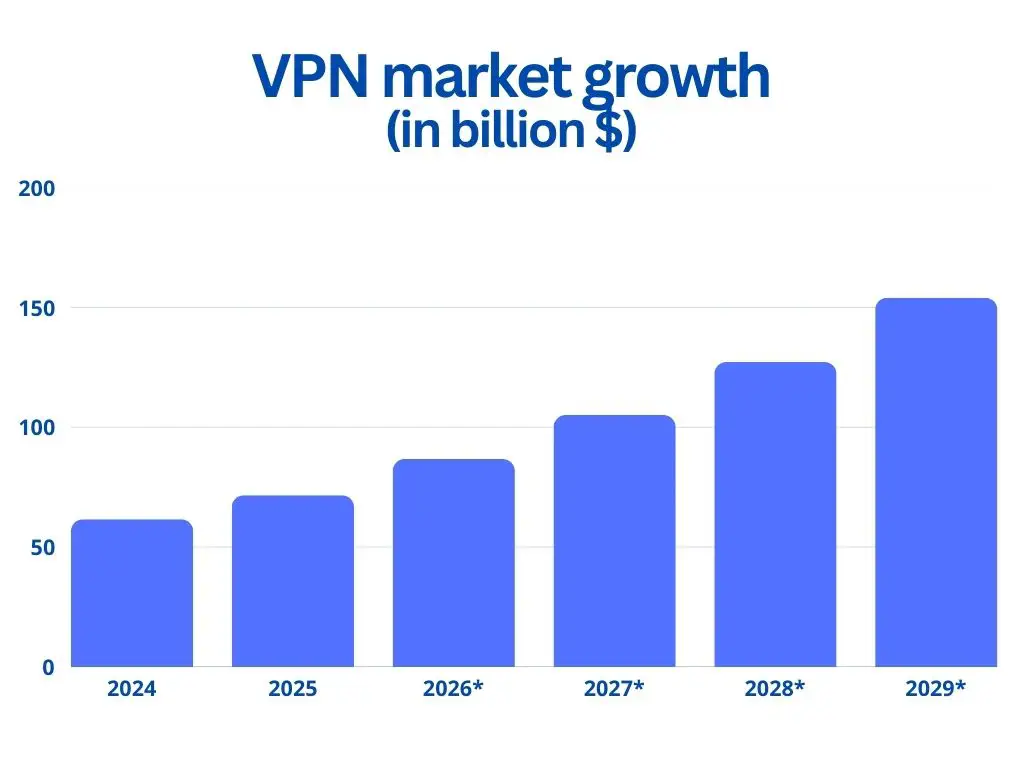
- The market value of VPNs is $71 billion and will reach $154 billion by 2029. (The Business Research Company)
- About 42.3% of users in the United Arab Emirates use a VPN. (Statista)
- A 52% of users believe they do not need a VPN. (Security.org)
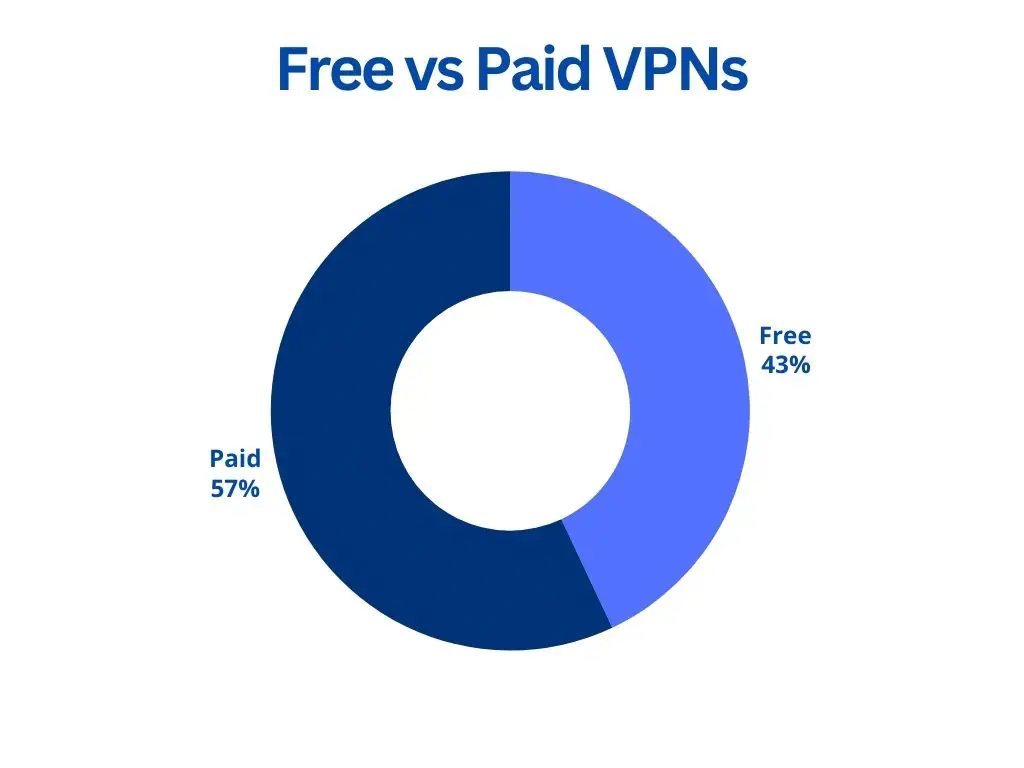
- The 43% of VPN users opt for a free version. (Security.org)
- The 88% of free VPNs on Google Play leak their users’ data. (Top10VPN)
- About 70% of companies have adopted a VPN to enable remote work. (Zscaler)
- Around 56% of companies using a VPN have suffered a cyberattack through their vulnerabilities. (ZScaler)
- About 91% of companies fear that using VPNs could jeopardize their business. (Zscaler)
VPN Market Statistics (2025)
How many people use a VPN?
As of today, it is estimated that 1.6 billion people around the world use a VPN to connect to the Internet. Analyzing the numbers on a scale, this corresponds to one third of the total Internet users and one fifth of the global population.
| GLOBAL POPULATION | INTERNET USERS | VPN USERS |
|---|---|---|
| 8.2 billion | 5.52 billion | 1.6 billion |
(Source: Surfshark)
The VPN market value is $71 billion
The market for virtual private networks (VPNs) has grown exponentially over the past few years. Today, its value is $71.66 billion and is estimated to experience a compound annual growth rate (CAGR) of 21.1% in the coming years. This means that by 2029, it will reach $154.09 billion.
- 2024: $61.42 billion.
- 2025: $71.66 billion.
- 2026*: $86.78 billion.
- 2027*: $105.09 billion.
- 2028*: $127.26 billion.
- 2029*: $154.09 billion.
(estimation*)
(Source: TheBusinessResearch)
NordVPN is the most used paid VPN
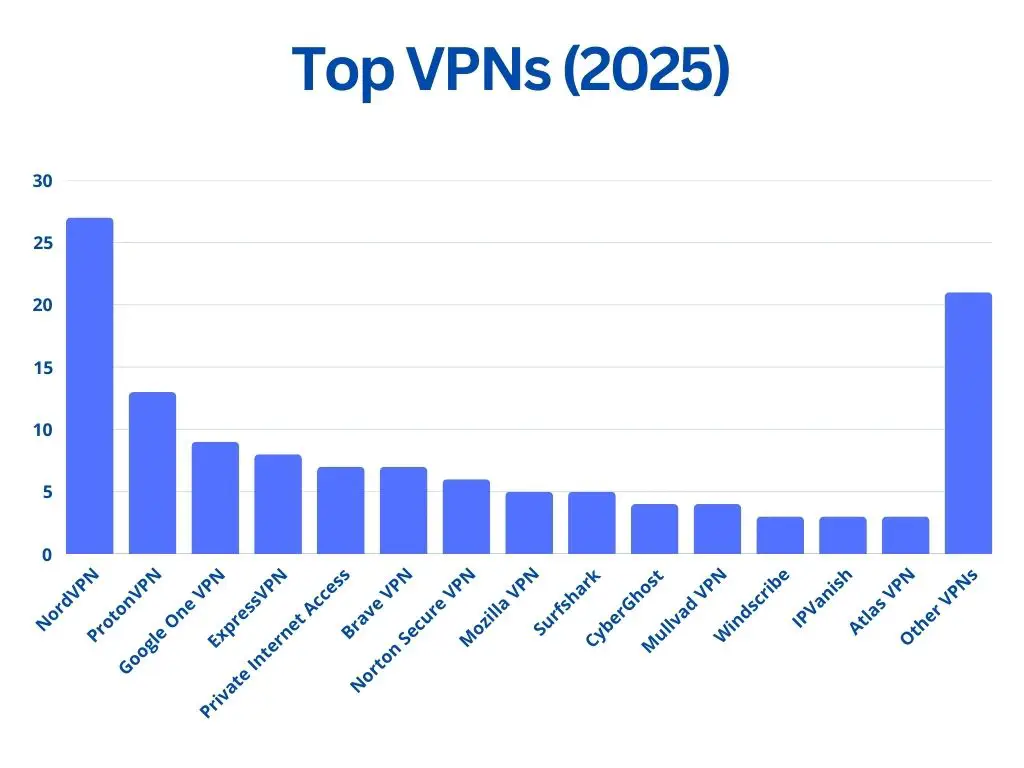
Analyzing the VPN market, as of today, NordVPN is the most used paid virtual network in 2025. According to a study published by Security.org, NordVPN has 27% of users, followed by Proton VPN (13%) and Google One (9%).
Below is a list detailing the most used VPNs of 2025:
- NordVPN: 27%
- Proton VPN: 13%
- Google One VPN: 9%
- ExpressVPN: 8%
- Private Internet Access: 7%
- Brave VPN: 7%
- Norton Secure VPN: 6%
- Mozilla VPN: 5%
- Surfshark: 5%
- CyberGhost: 4%
- Mullvad VPN: 4%
- Windscribe: 3%
- IPVanish: 3%
- Atlas VPN: 3%
- Others: 21%
(Source: Security.org)
VPN Usage Statistics (2025)
39% of VPN users use this service for work purposes
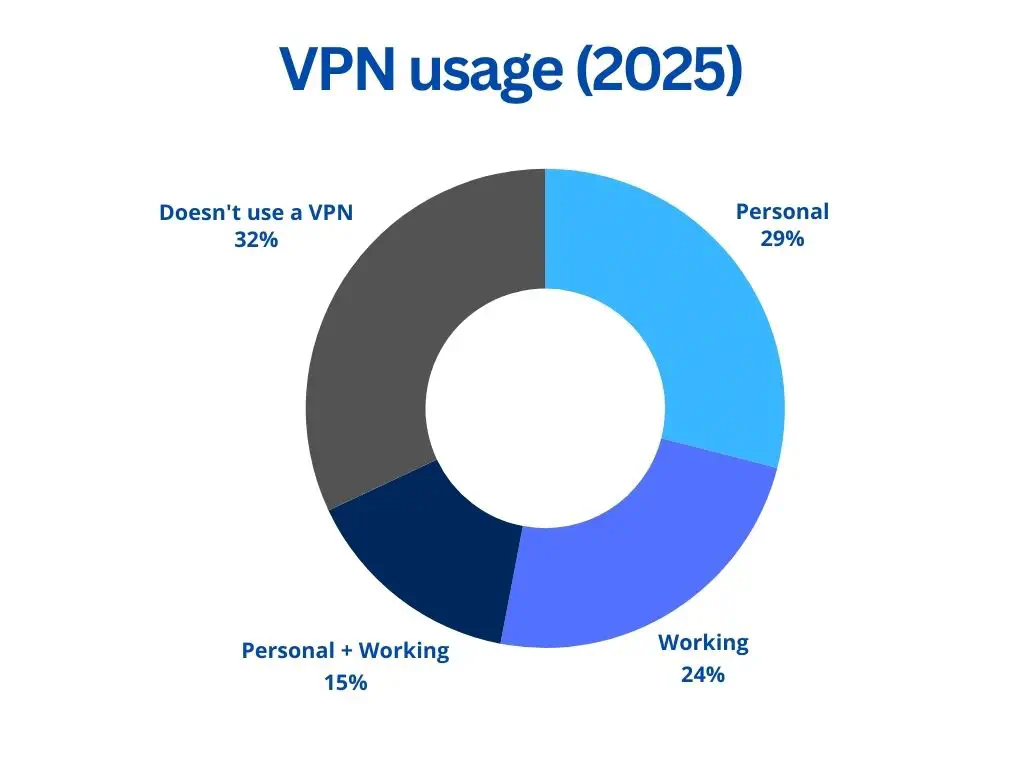
A recent study published by Security.org shows that approximately 40% of users of a virtual private network use it for remote work. These are divided between those who exclusively use the VPN for work (24%) and those who use it for both work and personal purposes (15%).
Below we detail the use of a VPN in 2025:
- Personal use: 29%
- Work use: 24%
- Personal and work use: 15%
- Does not use a VPN: 32%
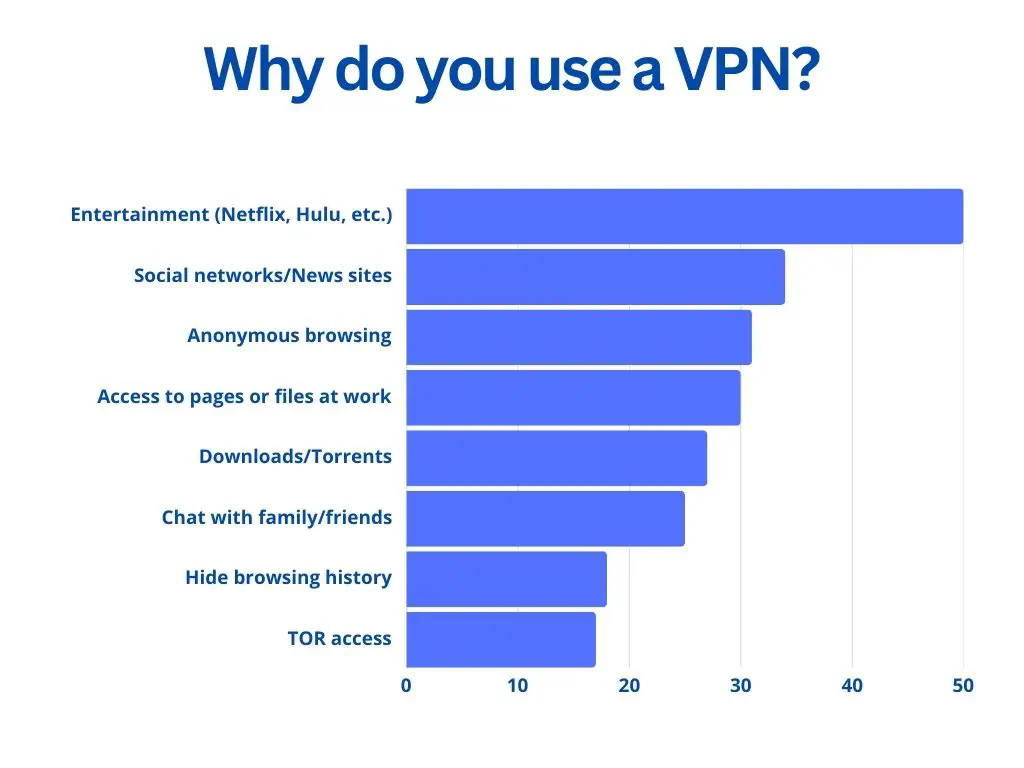
If we explore in detail the use of VPNs, we find that the main motivation for adopting this service is to access the full entertainment catalog of services like Netflix.
What do you use a VPN for?
Access to entertainment: 50%
Access to social networks/news pages: 34%
Maintain anonymity: 31%
Access pages/files/services at work: 30%
Access download/torrent pages: 27%
Talk to family/friends abroad: 25%
Hide my browsing history from the government: 18%
Access the TOR browser: 17%
(Source: GWI)
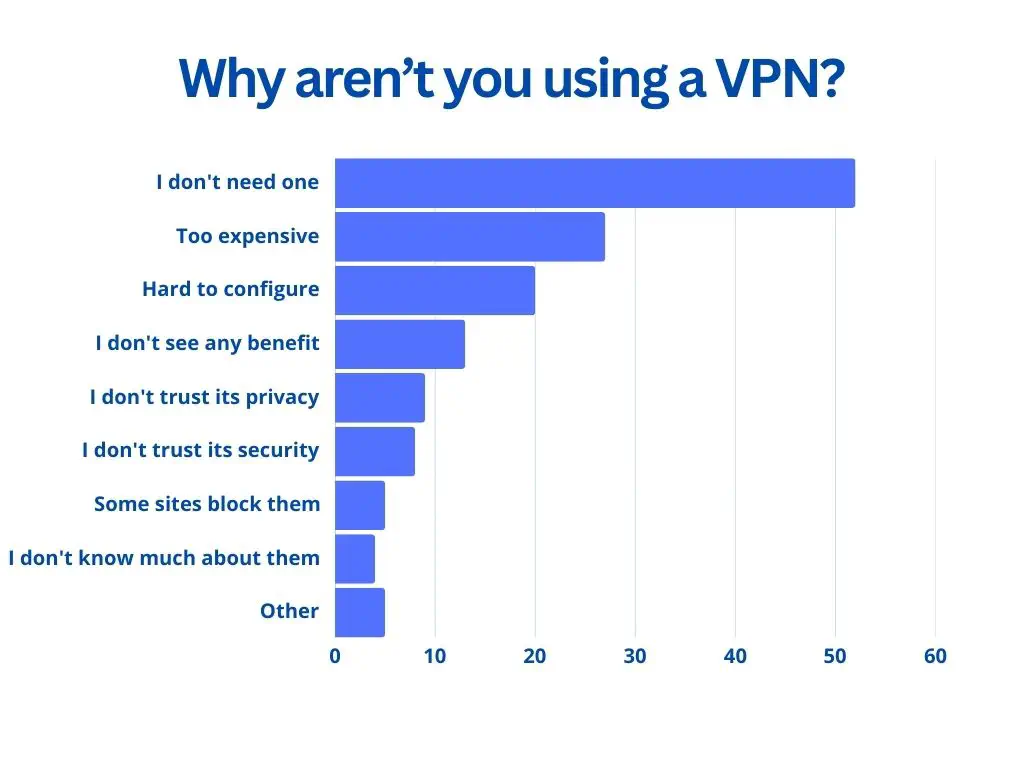
52% of users believe they do not need a VPN
Despite the fact that VPN usage has increased over the last few years, it is still much lower than expected. In fact, according to a recent survey conducted by Security.org, 54% of users still do not use a virtual private network to browse the Internet. The main reason for not using one is the widespread belief that it is not necessary to protect their data.
Q: Why do you not use a VPN?
- I don’t need one: 52%
- It’s too expensive: 27%
- It’s too difficult to set up: 20%
- I don’t see any benefit: 13%
- I don’t trust its privacy: 9%
- I don’t trust its security: 8%
- Many sites block them: 5%
- I don’t know much about them: 4%
- Other reasons: 5%
(Multiple responses may be chosen)
(Source: Security.org)
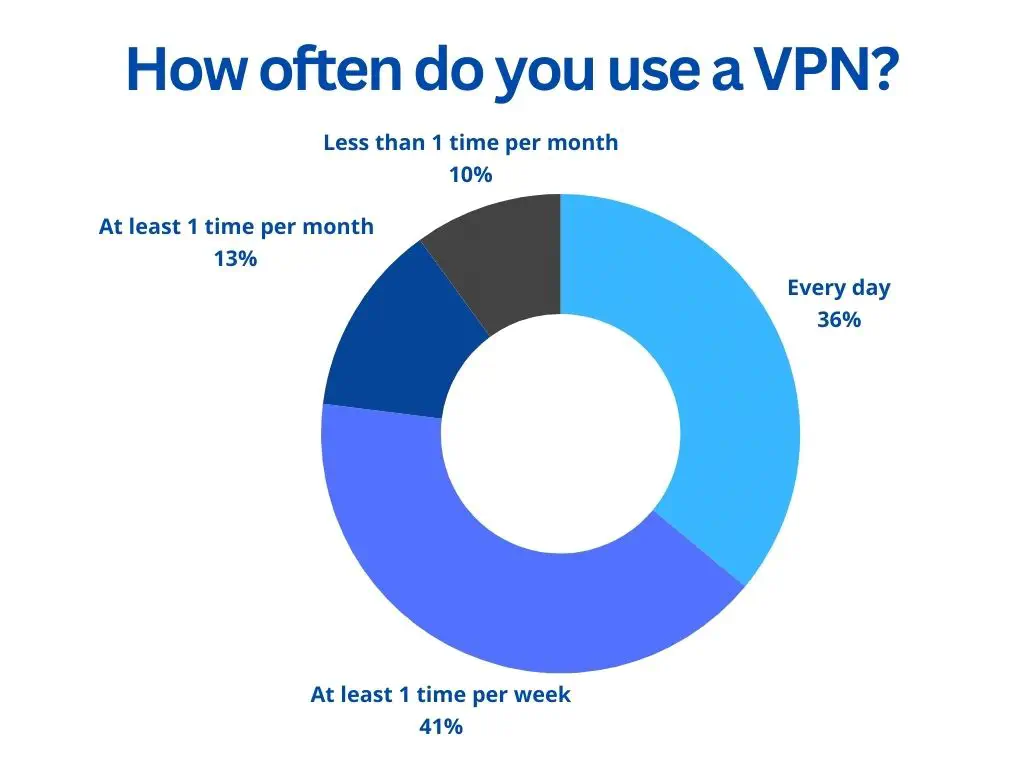
64% of VPN users do not use it daily
Not all VPN users utilize this virtual private network every time they connect to the Internet. In fact, only 36% admit to using it daily. This data substantiates the fact that the majority of users utilize a VPN solely for recreational purposes - such as accessing geo-blocked content - rather than to protect their data.
Q: How often do you use a VPN?
- Daily: 36%
- At least once a week: 41%
- At least once a month: 13%
- Less than once a month: 10%
(Source: Surfshark)
43% of users use a free VPN
A recent report by Security.org shows that almost half of users of a virtual private network opt for a free VPN.
(Source: Security.org)
The same study also concludes that the use of free VPNs comes with certain drawbacks. 60% of respondents admit to experiencing connection problems, including slow speeds in sending and receiving data (39%), presence of ads (13%), and issues when using streaming services (12%).
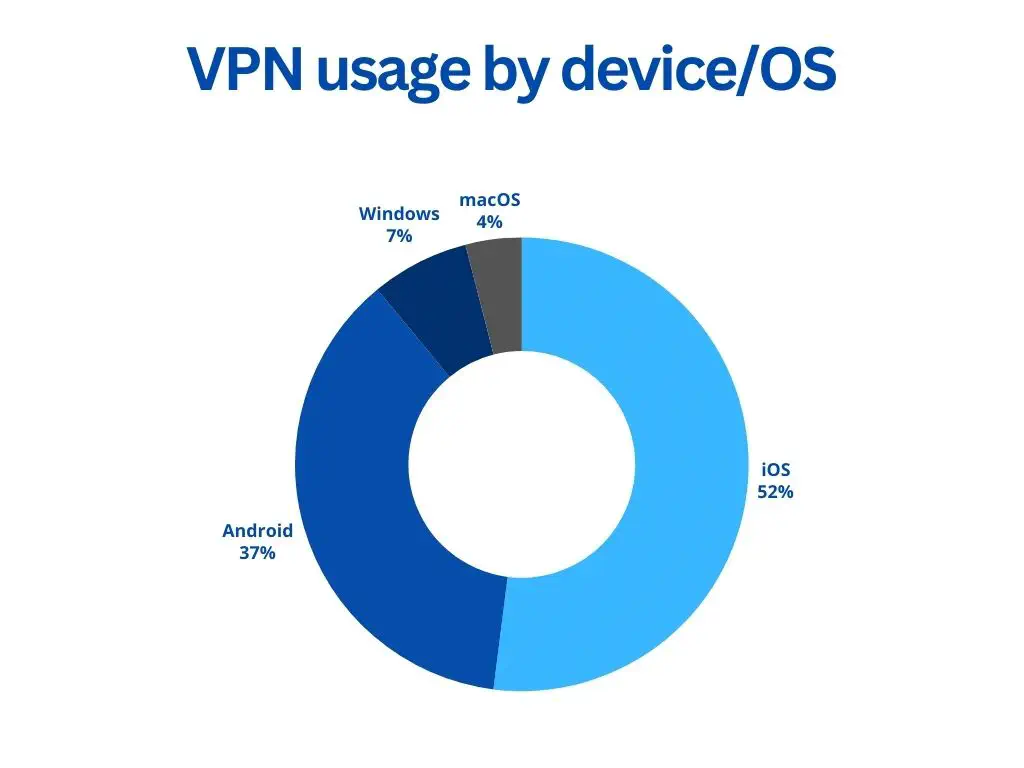
Which devices have the highest VPN usage?
When analyzing VPN usage by device, mobile devices account for 89% of the total. This is because most users utilize a virtual private network as a protective measure when accessing public Wi-Fi networks.
Q:* What devices do you use a VPN on?*
- iOS: 52%
- Android: 37%
- Windows: 7%
- macOS: 4%
(Source: Security.org)
VPN demographic statistics (2025)
Which country has the highest VPN usage?
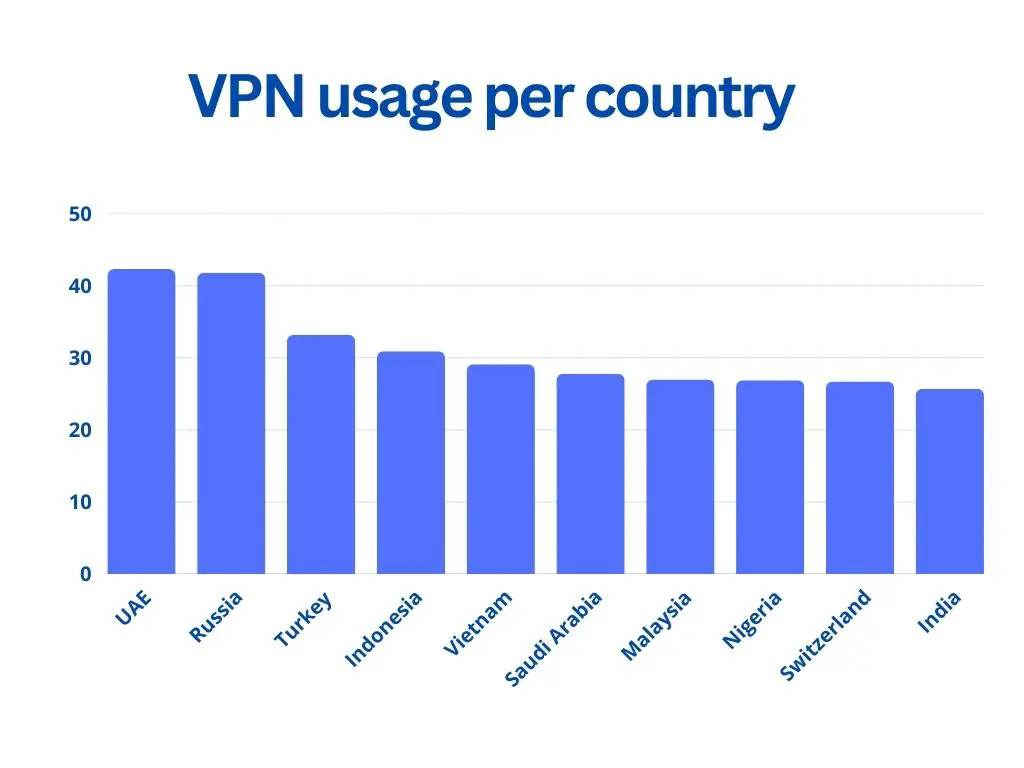
According to a recent report by Statista, the country with the highest VPN usage is the United Arab Emirates (48%). In second place is Russia with 41.8%, followed by Turkey (33.2%).
Below is a list of the top 10 countries with the highest use of virtual private networks:
- United Arab Emirates (U.A.E): 42.3%
- Russia: 41.8%
- Turkey: 33.2%
- Indonesia: 30.9%
- Vietnam: 29.1%
- Saudi Arabia: 27.8%
- Malaysia: 27%
- Nigeria: 26.9%
- Switzerland: 26.7%
- India: 25.7%
(Source: Statista)
Men use VPNs more than women
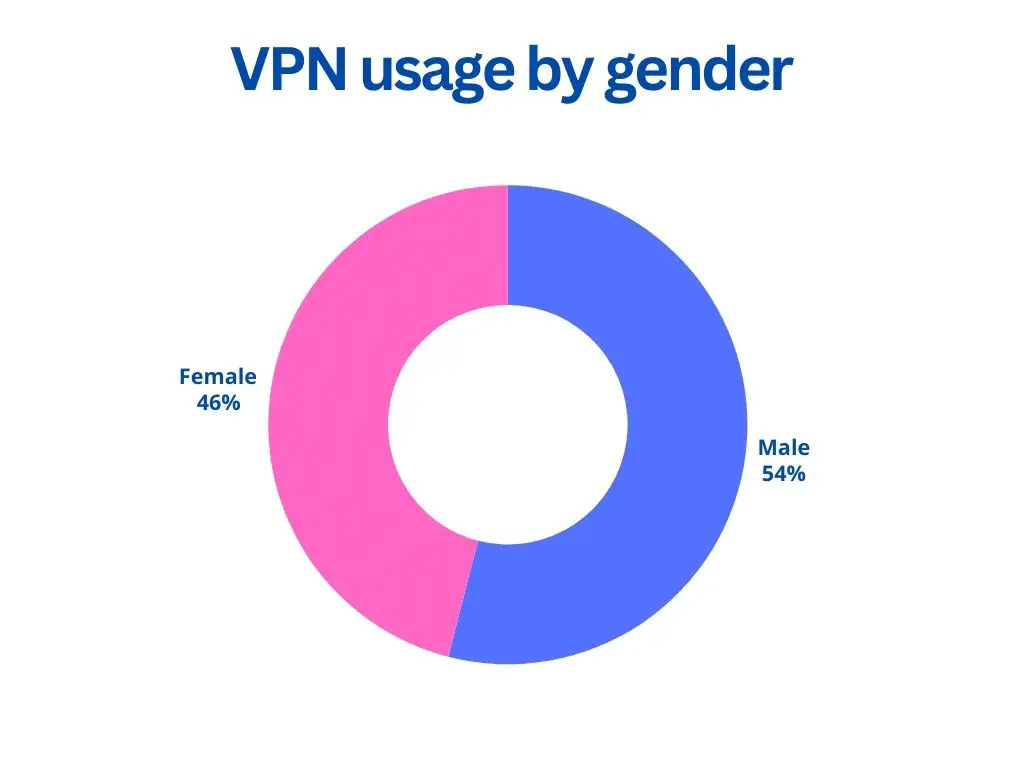
According to data collected by Surfshark, VPN usage is more common among men (54%) than among women (46%). Although the difference between both genders is subtle, it is significant as it has considerably decreased from the 62% that was previously reported by GWI.
(Source: Surfshark)
VPN usage is more common among Millennials (25-34 years)
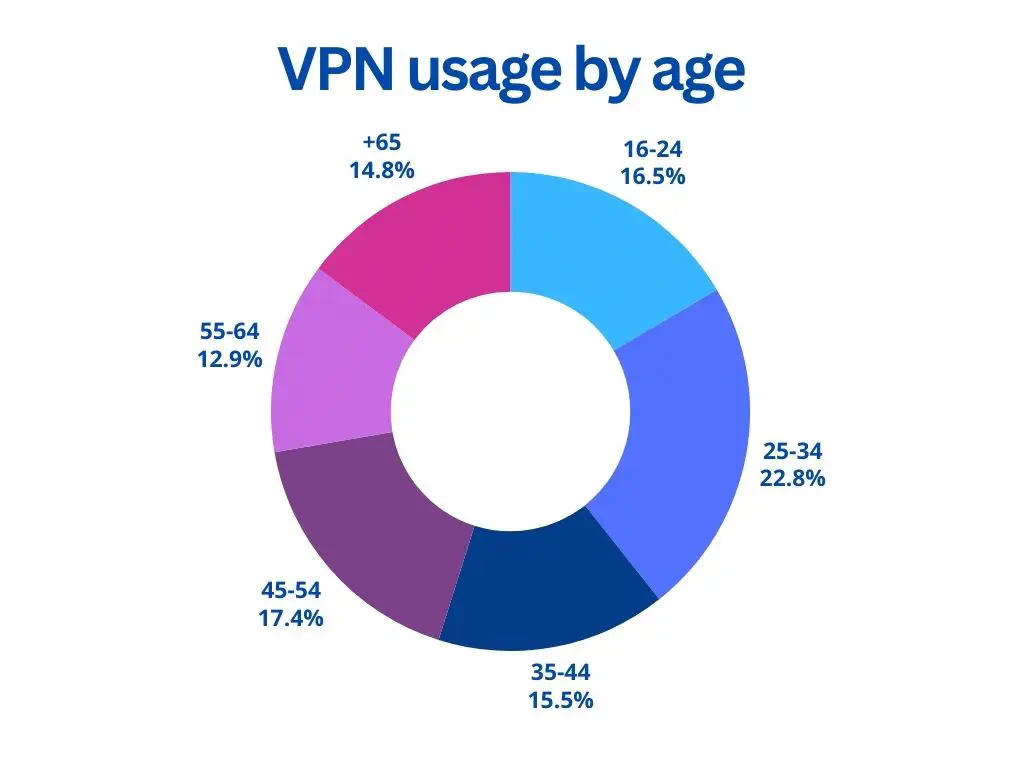
When analyzing VPN usage by user age, we can see that the use of a virtual private network is more prevalent among Millennials. A recent study published by Surfshark shows that 22.8% of VPN users are aged 25-34, followed closely by those aged 45-54 (17.4%).
Below are the detailed results of this study:
- 16-34 years: 16.5%
- 25-34 years: 22.8%
- 35-44 years: 15.5%
- 45-54 years: 17.4%
- 55-64 years: 12.9%
- 65+ years: 14.8%
(Source: Surfshark)
VPN Security Statistics (2025)
88% of Free VPNs for Android Leak User Data
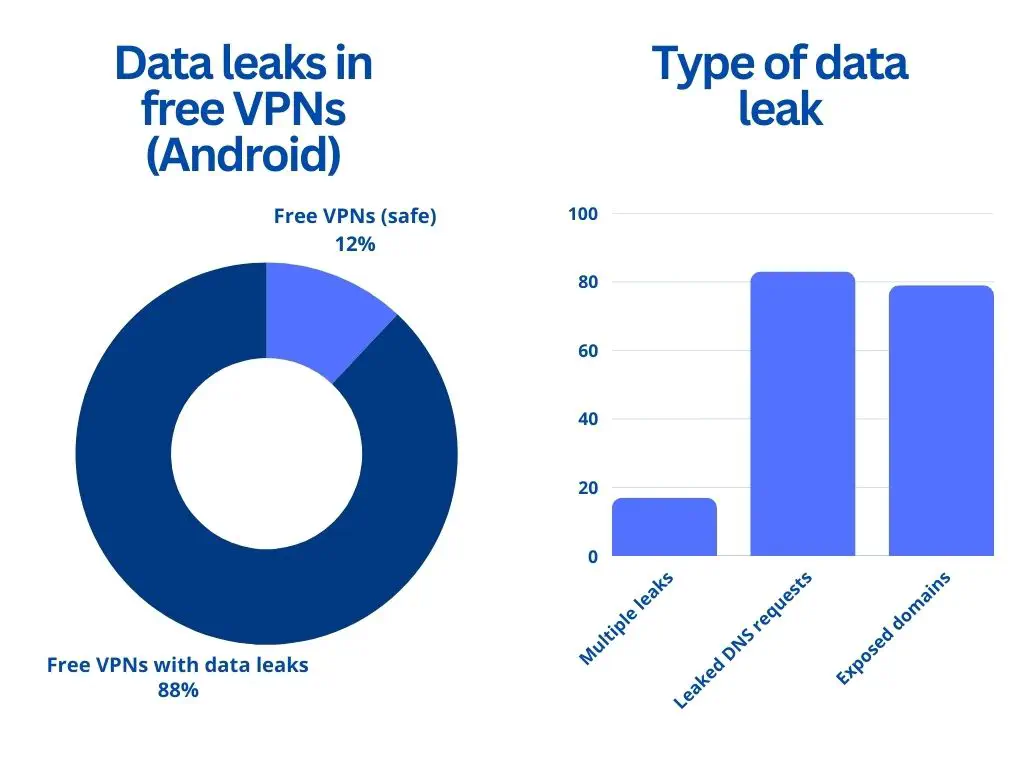
Despite security being one of the fundamental pillars of a VPN, not all adhere to these principles when providing their services. An alarming study conducted by Top10VPN has discovered that 88% of the free Google Play VPNs analyzed leak user data.
Among the main leaked data, we find:
- Multiple Leaks (IPv4, IPv6, DNS, WebRTC): 17%
- DNS Request: 83%
- Failures in sending all traffic through the tunnel: 79%
(Source: Top10VPN)
56% of Companies Have Been Victims of a Cyberattack Through Vulnerabilities in Their VPN Servers
The evolution of cyberattacks over the past few years is evident in the increase in attacks targeted at companies’ VPN servers.
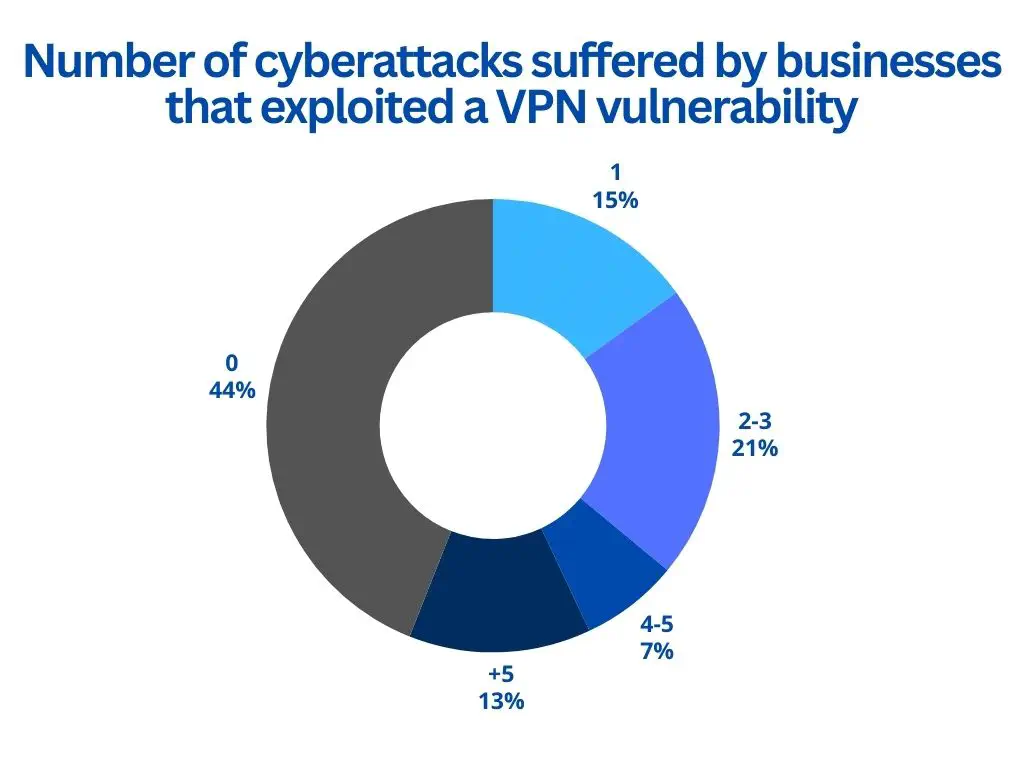
In a recent study conducted by Zscaler, we observe how 56% of businesses have been victims of a cyberattack using some vulnerability of their VPN servers. Compared to the data from the previous year, this type of attack has increased by 11%.
Q: In the past 12 months, how many times has your company experienced an attack using vulnerabilities in your VPN servers?
- 1 time: 15%
- 2-3 times: 21%
- 4-5 times: 7%
- More than 5 times: 13%
- Never: 44%
(Source: Zscaler)
91% of Companies Fear That Using VPNs May Endanger the Security of Their Business
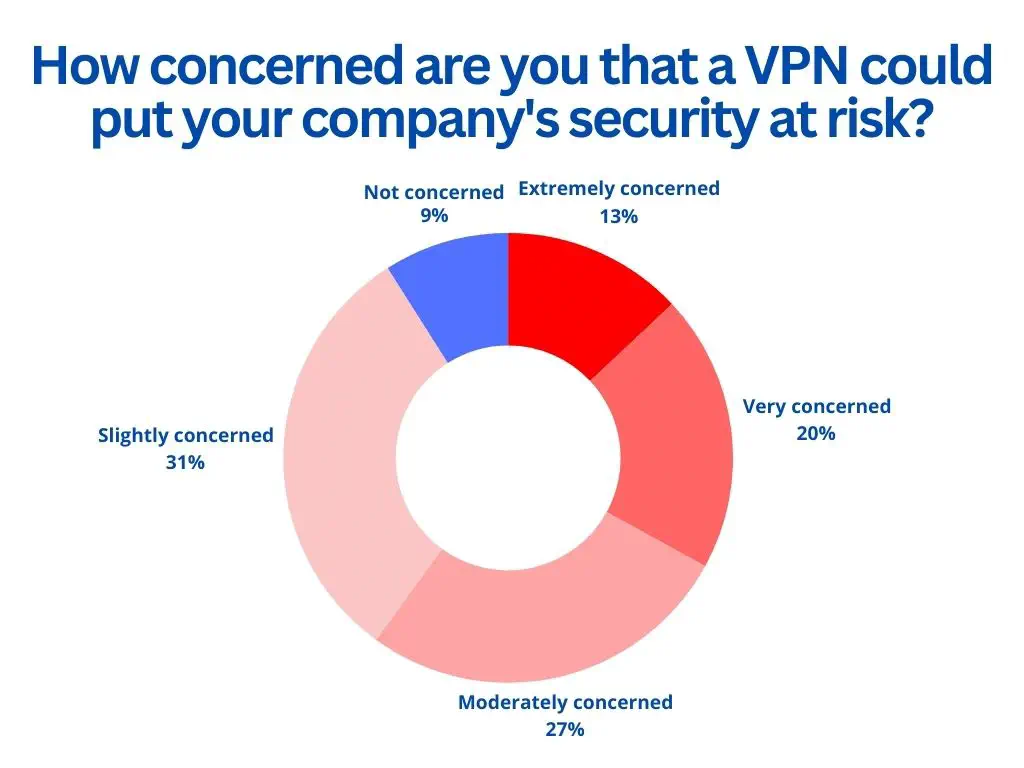
With the recent surge of cyberattacks targeting VPN servers, most companies express concern about using them. In fact, a study published by Zscaler shows how in 2025, 91% of businesses fear that using a VPN could jeopardize their company’s security.
One of the main reasons for this fear is that, as the report itself points out, 70% of companies have incorporated remote work into their business model, thus forcing the use of VPNs.
Q:* Are you concerned that using a VPN might jeopardize the security of your business?*
- I am very concerned: 13%
- I am quite concerned: 20%
- I am moderately concerned: 27%
- I am a little concerned: 31%
- I am not concerned: 9%
(Source: Zscaler)
Conclusion
The use of VPNs has become widespread over the last few years, largely driven by an increased need to protect online privacy and ensure a secure connection due to remote work. However, virtual private networks face a significant problem. And that is, although their adoption continues to grow at the personal and corporate levels, so does the number of cyber threats that exploit vulnerabilities in their servers.
With 56% of businesses affected by VPN security holes in the last year, it is clear that their traditional protection model is insufficient. However, services like NordVPN and NordLayer have already fortified their service by adopting a Zero Trust model for accessing their networks. This Zero Trust architecture is precisely what businesses need to overcome the limitations of a traditional VPN.
In the year 2025, it is crucial for companies and individuals to stay updated on the new risks lurking in the digital world. With the emergence of new models to secure our personal data, such as the Zero Trust model, it is necessary to consider its adoption to address the vulnerabilities presented by VPNs. And protecting our data has stopped being an option and become a genuine necessity.