
Secure Access Service Edge (SASE) is a cybersecurity framework that combines previously disjointed Network as a Service (NaaS) and Security as a Service (SECaaS) applications into a single cloud infrastructure.
By integrating essential tools like software-defined wide area network (SD-WAN), secure web gateways (SWG), firewall-as-a-service (FWaaS), cloud access security brokers (CASB), and zero trust network access (ZTNA), SASE effectively replaces fragmented point solutions with a cohesive platform built for the cloud era, making it ideal for today’s distributed workforces.
This convergence isn’t just about tidying up your tech stack; it’s about closing critical security gaps that often exist between disparate tools.
It helps reduce operational complexity for IT teams — according to the Hughes’ State of Network Access Report, 32% of IT professionals surveyed are in the process of implementing SASE solutions and 24% plan on implementing them in the next 12 months. It also ensures consistent security policies are applied across all users, devices, and locations, no matter where they connect from.
If you’re exploring how SASE can strengthen your business, we’re here to help you find the right SASE solution for your needs.
What option to choose?
SASE Solutions Summary
| Solution | Good For |
|---|---|
| Prisma SASE by Palo Alto Networks | Large enterprises or high-compliance industries with mature security teams and the budget to deploy a highly scalable, AI-driven cloud-native platform |
| Zscaler Zero Trust SASE | Larger organizations seeking zero trust architecture with extensive integrations, a high-availability global network, and a good user interface |
| FortiSASE by Fortinet | Organizations with existing Fortinet infrastructure who need unified policy enforcement across on-prem and cloud |
| Cato SASE Cloud | Mid-sized businesses that need a SASE solution with an intuitive UI and don’t require complex integrations and extensive bandwidth |
| Netskope One SASE | Organizations looking for granular detail and policy control that have internal expertise to set up and maintain the solution |
| Cloudflare One | Organizations that want a scalable, cloud-native SASE platform with strong performance, broad feature coverage, a flexible pricing model, and free testing solution (up to 50 users) |
| Versa SASE | Organizations who are undergoing cloud migration who need hybrid deployment flexibility and multi-tenant support |
| Harmony SASE (Previously Perimeter 81) | Organizations that need powerful built-in analytics and policy control, and have the IT expertise to manage a more complex setup |
| NordLayer by Nord Security | Price-conscious small and mid-sized organizations that need an easy-to-use, low-maintenance SASE entry point without SD-WAN or complex integrations |
| Cisco Secure Access Service Edge | Large enterprises with existing Cisco infrastructure and generous budgets that prioritize easy deployment and regulatory compliance |
The Components of SASE Architecture
Five core network and security components make up a SASE solution. Together, these create a unified, cloud-native framework that improves security for a dispersed workforce.
SASE solutions may also offer extended capabilities such as data loss prevention (DLP) and identity and access management (IAM). The maturity of each SASE component and the breadth of additional features vary by provider, so the right solution for you often depends on your specific security needs.
Software-Defined Wide Area Networking (SD-WAN): This technology optimizes network traffic routing across wide area networks, improving application performance and reliability by dynamically selecting the best path based on network conditions. It forms the network foundation for SASE.
Firewall as a Service (FWaas): A cloud-based firewall, this component delivers advanced Layer 7/next-generation firewall capabilities, providing consistent threat protection and access control for all traffic, regardless of location.
Secure Web Gateway (SWG): This filters out unwanted software and malware from user-initiated web traffic and enforces corporate security policies, protecting users from web-based threats as they access the internet.
Cloud Access Security Broker (CASB): Acting as an intermediary between users and cloud service providers, this component enforces security policies, provides visibility into cloud usage, and ensures compliance as you adopt cloud applications.
Zero Trust Network Access (ZTNA): Following a “never trust, always verify” standard, this grants users access only to specific applications or resources they need rather than giving them broad network access, which significantly reduces your attack surface.
Key SASE Provider Considerations
When you’re evaluating different SASE providers, certain key factors should guide your decision-making process to ensure the solution you choose aligns with your organization’s security, operational, and financial needs.
- Security features: Consider which advanced, built-in security tools each SASE solution offers and understand if it complies with regulations such as GDPR, HIPAA, and SOC 2.
- Total cost of ownership: Make sure you understand what’s included in base pricing versus premium features, and how the pricing structure will scale with your usage needs.
- Implementation: The solution should offer straightforward deployment processes with an intuitive management interface. A clear migration path from legacy systems is also essential to minimize disruption during the transition.
- Network performance: Assess the provider’s backbone architecture, availability of global PoPs, and performance metrics like latency and packet loss.
- Scalability: A strong provider should have numerous Points of Presence (POPs) strategically located near your users and resources to reduce latency and provide consistent service. The infrastructure should handle traffic spikes reliably and demonstrate a history of innovation to meet evolving industry demands.
- Support: Providers should deliver responsive, knowledgeable, supportive services that are readily available when needed. Look for formal SLAs with specific uptime guarantees and latency resolution guidelines to ensure accountability.
The Best SASE Solution Service Providers
Based on industry analysis, here are ten leading SASE solutions to consider in 2025. Each offers a unique blend of features, strengths, and potential drawbacks.
1. Prisma SASE by Palo Alto Networks
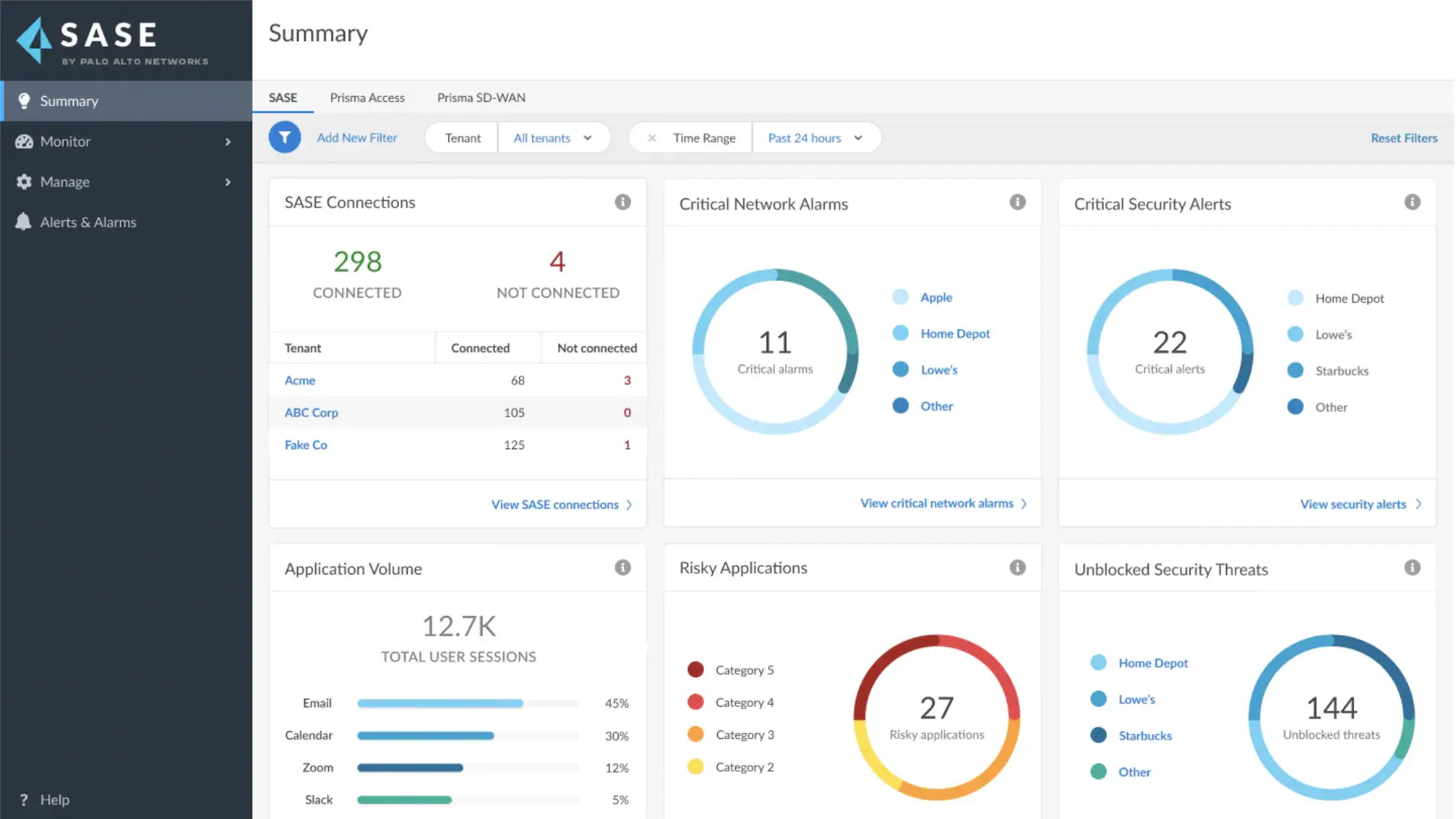
Best for: Large enterprises or high-compliance industries with mature security teams and the budget to deploy a highly scalable, AI-driven cloud-native platform
Pros:
- Cloud native
- Highly scalable
- Highly automated
- AI-integrations
- Granular threat detection
Cons:
- Time-consuming and difficult to configure
- No private backbone
- High cost
| Category | Summary |
|---|---|
| Security Features | |
| ZTNA 2.0, Cloud SWG, NG-CASB, FWaaS, SD-WAN, ADEM, SSPM, UEBA, email DLP, AI-powered data classification, end-user coaching, and more |
ISO27001, ISO27017, ISO27018, ISO27032, and ISO27701 certified, ISMAP and
Soc 2+ compliant, and more. |
| Pricing | Unlisted (but reportedly very high cost) |
|---|---|
| Implementation | Difficult to implement and maintain |
| Network Performance | No private backbone; but users typically happy with the level and consistency of connectivity |
| Scalability | Highly scalable for organizations that are not cost-sensitive and have internal support |
Founded in 2005 as a network security company, specializing in NGFW, Palo Alto Networks released its SASE solution, Prisma SASE, in 2021. The company was already well-established and known for innovating and leading the industry in multiple categories, according to Forester and Gartner. Fittingly, its take on SASE is one of the few purpose-built, cloud-native SASE solutions on the market.
This cloud-native solution is highly scalable with powerful automation and AI integrations for granular threat detection. Extensive certified integrations and technology partners are usually good signs that the tool can scale with your needs, especially given the detailed compatibility matrix to guide users in implementing firewall integrations. That said, the level of integrations required to make the most of the platform may become cost-prohibitive for some organizations.
The Autonomous Digital Experience Management add-on is unique to Prisma SASE. It shows how apps and networks are performing for users at different locations, using info from devices, test runs, and real user activity. If something slows down or breaks, ADEM helps pinpoint the issue fast so IT can fix it and keep business moving.
Now, the downsides: This tool requires a lot of internal expertise to configure and maintain, especially because of lacking customer support.
If you don’t integrate with a service provider backbone, the platform will use public cloud providers for network backbone. Relying on public cloud providers for the network backbone can lead to less predictable performance. However, Prisma SASE minimizes latency issues by using a multi-cloud setup. Also, although the price is unlisted publicly, the costs are reportedly high.
Prisma SASE by Palo Alto Networks is one of the most comprehensive solutions on the market with a powerful API infrastructure. However, that does come with complexity and a high price tag that not all organizations will be able to accommodate.
2. Zscaler Zero Trust SASE
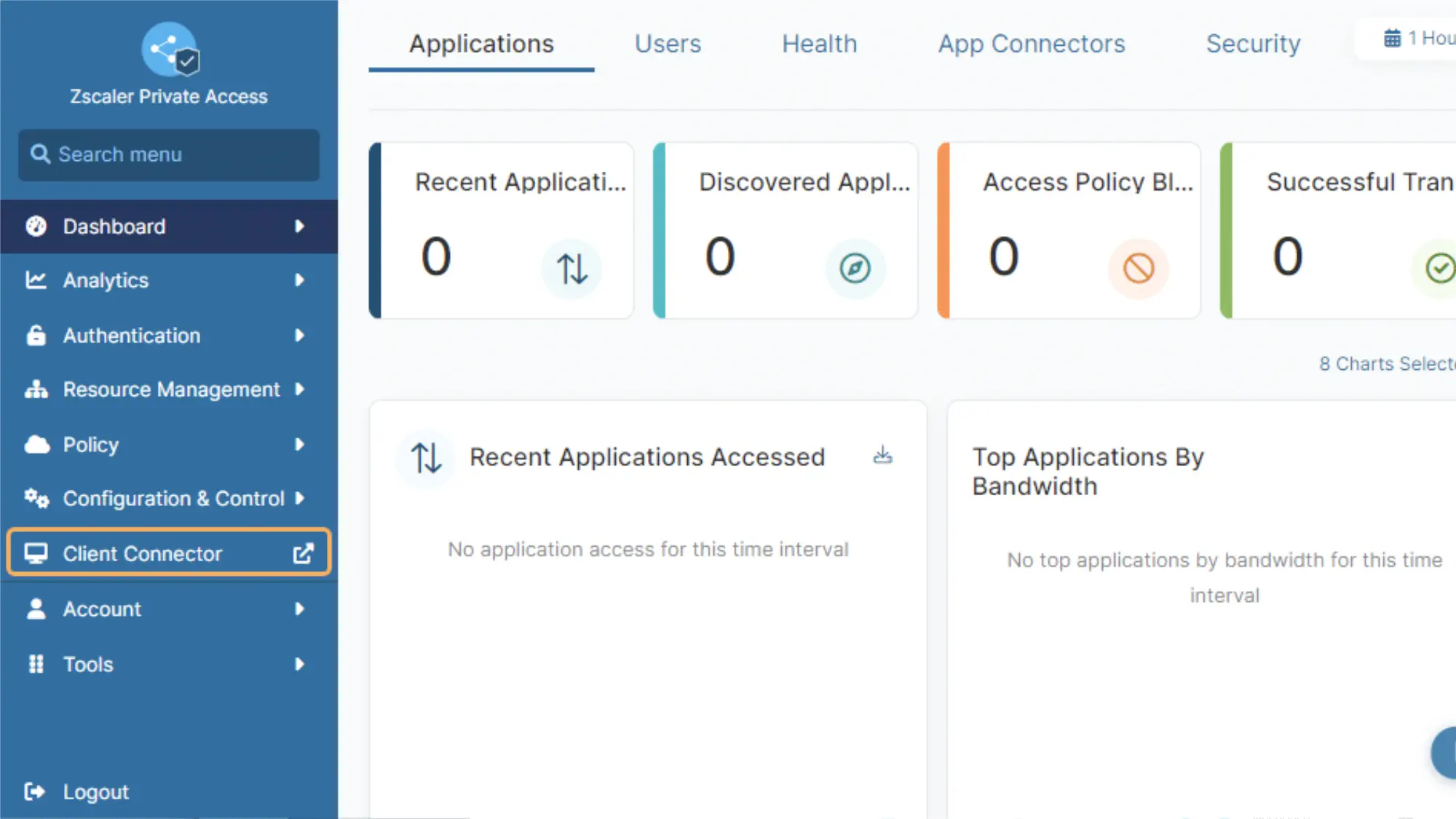
Best for: Larger organizations seeking zero trust architecture with extensive integrations, a high-availability global network, and a good user interface
Pros:
- Intuitive interface
- Zero trust SD-WAN
- Extensive integrations
- Comprehensive compliance
Cons:
- Complex configuration
- Licensing costs and additional charges for some features
- Less mature SD-WAN
At a Glance:
| Category | Summary |
|---|---|
| Security Features | |
| Includes SD-WAN, SWG, CASB, FWaaS, ZTNA, DXM |
Most comprehensive compliance certifications of any other provider, including ISO2700, ISO2770, ISO27018, ISO27017, SOC 2, Type II, SOC 3, and HIPAA among others |
| Pricing | Unlisted/custom quote |
|---|---|
| Implementation | Very complex to configure for a successful deployment, but easy to use once implemented |
| Network Performance | Over 150 PoPs globally, though some users have mentioned latency issues |
| Scalability | Designed as a cloud-delivered service that scales but has costs and additional charges |
Founded in 2007, Zscaler is a publicly traded company and a well-established cybersecurity provider. Its SASE solution is relatively new to the market, launched in January of 2024.
The company’s unique value proposition is that its AI-powered SD-WAN functionality is superior to other SASE providers who rely on traditional SD-WAN infrastructure.
Once it’s set up, Zscaler is easy to use and has an intuitive interface. It integrates with major identity and endpoint platforms, including Entra ID, ADFS, CrowdStrike, and Intune, and users report smooth integration experiences. Zscaler has over 150 PoPs, ensuring low-latency, high-performance connectivity across the globe. Its Zero Trust SD-WAN solution is unique, providing secure branch connectivity without routed overlays.
Despite its user-friendly interface post-setup, Zscaler SASE has a steep learning curve during initial deployment, particularly for teams without robust IT resources. This solution has extensive licensing costs and additional charges for some features. Also, bear in mind that it’s a relatively new solution with less testing. Its SD-WAN implementation is less mature than that of dedicated solutions, such as Cisco’s or VMware’s, which offer broader support for hybrid environments.
That said, Zscaler may be a strong fit for large, security-conscious enterprises seeking a fully cloud-delivered, zero trust solution with extensive integrations and compliance credentials.
3. FortiSASE by Fortinet
Best for: Organizations with existing Fortinet infrastructure who need unified policy enforcement across on-prem and cloud
Pros:
- Ease of adoption and implementation within the Fortinet environment
- Strong threat protection
- Product transparency
Cons:
- Limited flexibility and compatibility in mixed-security environments
- PoP access is limited based on the licensing tier
- An expensive option, especially for small deployments
At a Glance:
| Category | Summary |
|---|---|
| Security Features | |
| Includes SWG, FWaaS, ZTNA, CASB, SD-WAN, IPS, DNS filtering, DLP, RBI, DEM, and more |
SOC2 Certified, ISO27001, ISO27017, ISO27018, ISO9001 certified, HIPAA compliant, GDPR compliant, ISMAP certified, and more |
| Pricing | Custom quoted with user-based licensing |
|---|---|
| Implementation | Straightforward and smooth integration with existing Fortinet security infrastructure; assisted onboarding included in licensing |
| Network Performance | Solid network performance and stable throughput under high connection loads, but possible limited of PoPs, dependent on licensing tier |
| Scalability | Scalable with a Unified SASE Control |
Fortinet is a well-known publicly traded cybersecurity company, founded in 2000. The company is part of the United Nations Global Compact (UNGC) and was listed in the top ten most trusted companies by Forbes in 2025. Fortinet launched FortiSASE in 2022. Like many other companies, it has developed a SASE solution on top of pre-existing legacy platforms, but this is not a cloud-native solution.
FortiSASE by Fortinet is easy to adopt and implement and has comprehensive built-in functionality for organizations with a cloud-based network environment. To that end, it offers straightforward and smooth integration with existing security infrastructure, as long as it’s not a mixed-security environment.
It has excellent security features: When tested by CyberRatings.org, it received a 99.02% and 99.5% in the exploit and malware categories. FortiSASE supports reverse proxy, which protects networks from direct attacks by filtering malicious requests. It also has AI-powered threat detection and sandboxing to block attacks.
Good product transparency appeals to users, and the Digital Experience Monitoring feature helps administrators troubleshoot issues on their own, without looping in tech support, for faster resolution.
While FortiSASE is easy to set up if you’re already using the Fortinet ecosystem, fully leveraging FortiSASE’s hybrid capabilities may require advanced configuration, such as custom policy creation and integration with Fortinet SD-WAN or FortiGate devices.
Organizations should also be prepared to pay for scalability, as PoP access is based on the licensing tier. And, as previously mentioned, there’s poor infrastructure for mixed-security environments (such as, on-premise and cloud). User reviews on support responsiveness are also mixed. While pricing is custom, users report that it’s an expensive solution, especially for smaller deployments. Fifty users is the minimum.
FortiSASE is like many other organizations that have developed SASE solutions on top of pre-existing legacy platforms; it checks a lot of SASE boxes, but doesn’t have an infrastructure to support a seamless SASE experience, especially in mixed-network environments.
4. Cato SASE Cloud
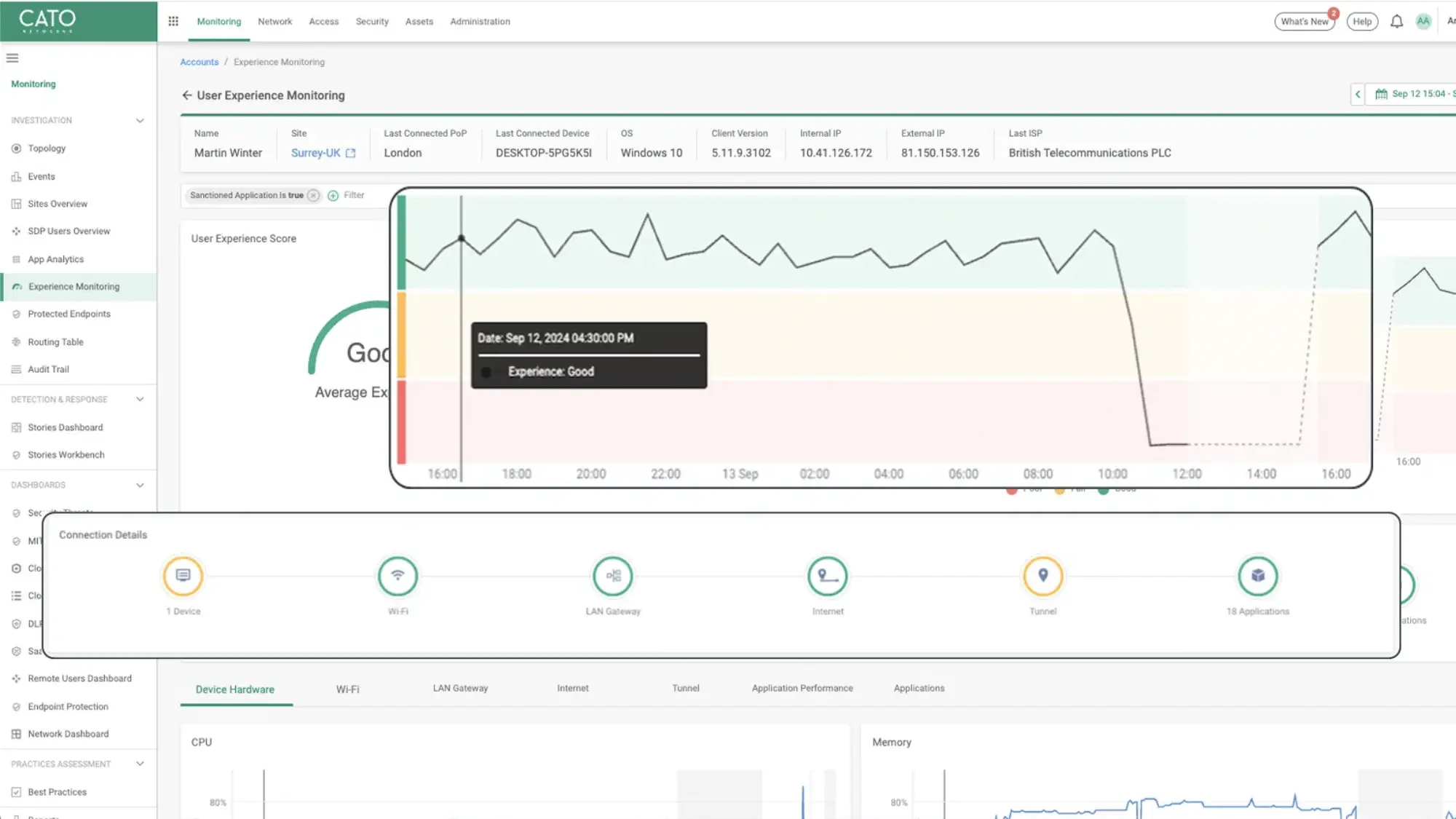
Best for: Mid-sized businesses that need a SASE solution with an intuitive UI and don’t require complex integrations and extensive bandwidth
Pros
- All-in-one native architecture
- Intuitive UI with a centralized interface
- Global private backbone
Cons
- Poor compatibility with existing services and integrations
- Cost-prohibitive at scale
- Less flexibility for large enterprises with custom security needs
At a Glance:
| Category | Summary |
|---|---|
| Security Features | |
| Includes SD-WAN, ZTNA, FWaaS, SWG, CASB, threat prevention, and extended detection and response capabilities; lacks advanced features and has limited third-party and identity provider integrations |
GDPR compliant, SOC 1, SOC 2, SOC 3 certified, ISO2700 ISO127017, ISO27018, ISO27701 certified, and more |
| Pricing | Based on bandwidth usage with Cato Socket devices required at each site |
|---|---|
| Implementation | Relatively easy implementation and UI, but may not work well with legacy systems |
| Network Performance | Global private backbone with 85+ PoPs, which is fewer than many competitors |
| Scalability | Strong infrastructure, but pricing model can be restrictive |
Cato SASE Cloud was launched in 2016 by industry veterans. It holds the distinction of being the first SASE cloud platform built from the ground up, unlike other products on the market that developed their SASE solutions on top of their existing products.
Because Cato is not just a SASE solution cobbled together from existing products, the UI is more intuitive. It’s relatively easy to deploy and monitor, though there may be a learning curve to navigating the Cato Management application (CMA), which lets you manage everything in a single interface.
Another key benefit is its global private backbone. Unlike some other SASE solutions that route traffic on the internet or third-party infrastructure, its interconnected private backbone ensures security services are close to the user and scalable.
Cato’s SASE platform also has self-healing capabilities, meaning that it can recover from failures and switch to alternate paths without manual intervention. However, it only has 85-plus points of presence (PoPs), which is fewer than some competitors. PoPs close to users can reduce latency and increase performance, — in general, the more at your disposal, the better.
Because Cato was built as a standalone product, it has poor compatibility with some existing services and integrations your organization may already have. For example, Android devices have had trouble connecting to resources. Secure private applications also face limitations and only partial support for operational technology authentication.
Pricing can be an issue for companies that use a lot of bandwidth, as its pricing is primarily based on bandwidth volume. Additionally, Cato Socket SD-WAN devices are required at each site to connect to the nearest PoP, which adds to the overall cost.
Cato’s native architecture, strong private backbone, and clean interface make it a compelling choice for organizations that value ease of use over deep customization. Just be mindful of integration needs and potential scaling costs.
5. Netskope One SASE
Best for: Organizations looking for granular detail and policy control that have internal expertise to set up and maintain the solution
Pros:
- Superior detail and visibility
- Granular policy control
- Ease of integration
Cons:
- Not user-friendly and complex setup
- High cost relative to functionality
- Poor support
- Fewer built-in features than other providers
At a Glance:
| Category | Summary |
|---|---|
| Security Features | |
| Includes SWG, CASB, ZTNA, FWaaS, SD-WAN, DNS filtering, threat protection, and more |
SOC 2 compliant, HIPAA Compliant, ISO27001, ISO270017, ISO27018 certified, and more |
| Pricing | Unlisted/custom quoted |
|---|---|
| Implementation | Not user-friendly and complex setup |
| Network Performance | Sub-5 millisecond on-ramp latency in many regions, backed by 75+ global data centers and coverage across 220 countries |
| Scalability | Cloud-native architecture for growth support |
Netskope is a network security company founded in 2012. It launched an on-premises CASB in 2015 and acquired Infiot in 2022 to deliver a fully integrated single-vendor SASE platform.
In March 2024, the company improved its SASE solution with Netskope One SASE. Since then, it has been improving the platform and adding new capabilities like DLP on demand and AI-driven DEM. Netskope aims to be the leading SASE solution for midmarket companies and managed service providers.
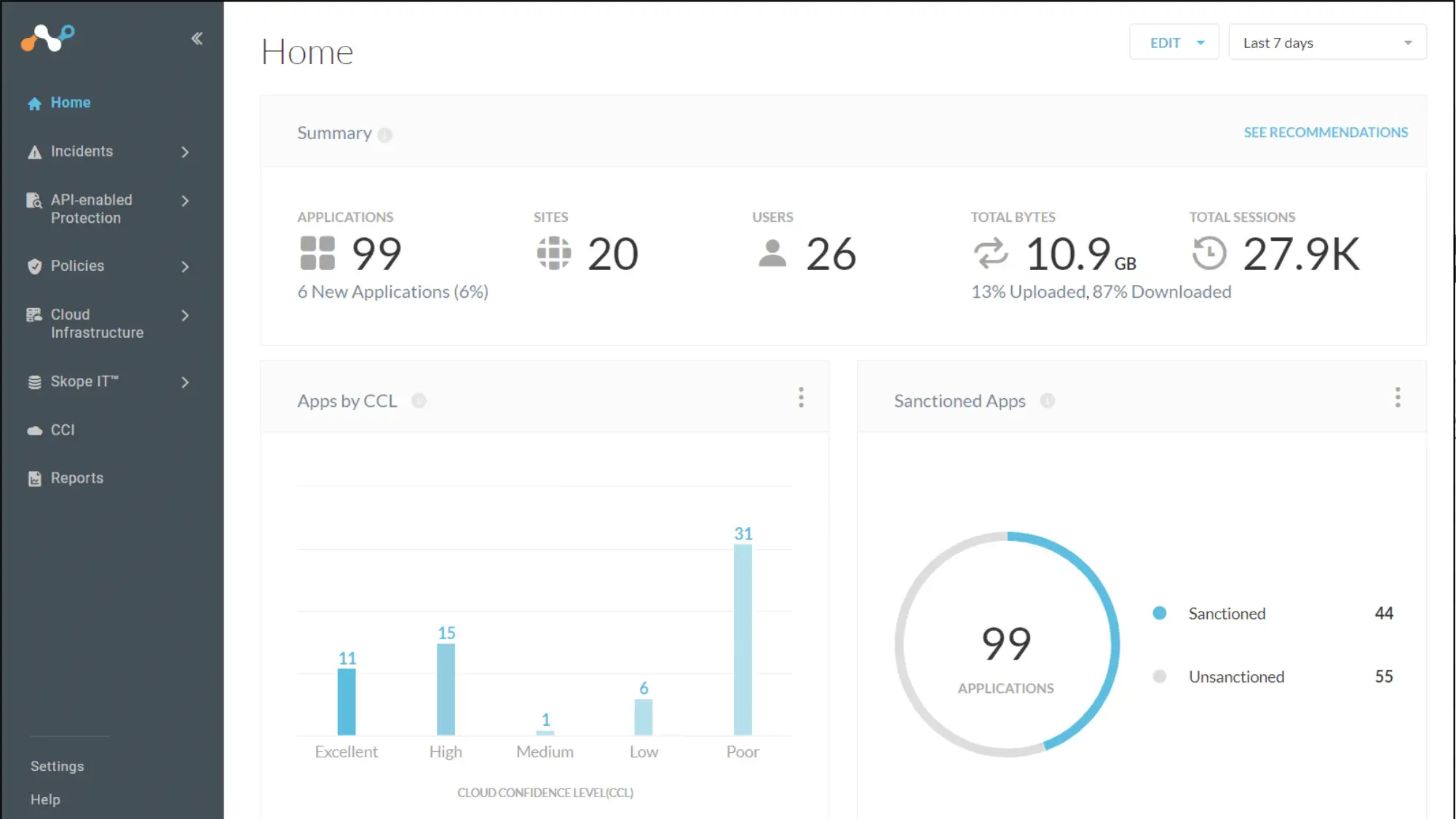
Netskope has superior reporting detail and visibility and easily integrates with most common SaaS providers. Users love the detail of security reporting, granular policy control, and transparency from the vendor about incidents and maintenance.
Netskope has data centers in 75-plus regions with coverage to 220 countries and offers a speed test that shows expected latency by use case. Average on-ramp latency is less than five milliseconds in many countries, though latency is higher in some parts of Southeast Asia and in India.
Given that Netskope One SASE is still evolving, users complain that the functionality does not warrant the cost. It’s not the most user-friendly solution — setup is complex, and support is so unreliable that it’s driven some users to abandon the platform altogether. It also may not be scalable for larger organizations, as some users have reported latency under high-volume traffic.
Netskope One SASE offers superior visibility with granular policy control and easy integration capabilities but suffers from complex setup, inadequate support, and pricing that many users feel doesn’t align with its functionality.
6. Cloudflare One
Best for: Organizations of all sizes looking for a high-performance, feature-rich Zero Trust and SASE platform with flexible pricing, including a free tier
Pros:
- PoPs near most major geographic areas
- Extensive interconnected network
- Free Forever plan (for up to 50 users)
- Strong integration capabilities
- Great value for the cost
- 100% uptime guarantees
Cons:
- Lack of advanced features like custom management and reporting
- Initial setup can be complex
- Poor support unless you’re an enterprise user
At a Glance:
| Category | Summary |
|---|---|
| Security Features | |
| Includes WANaaS, ZTNA, SWG, FWaaS, CASB, DEX, basic DLP, RBI, email security, and Network services for SASE |
GDPR compliant, SOC 2 certified, ISO27001, ISO27017, ISO27018, ISO27701 certified, and more |
| Pricing | $0 free plan, $7/user/month pay-as-you-go plan, or custom quoted contract plan |
|---|---|
| Implementation | Difficult to set up and manage |
| Network Performance | Servers in over 300 cities, interconnects with 8,800 networks globally, hardware-free load-balancing, 100% uptime guarantees |
| Scalability | Strong integration capabilities, but lacks advanced features like custom management and reporting |
Cloudflare One was launched in 2020. Because the company only recently started developing its SASE offering, it has some catching up to do on more advanced features, custom management, and reporting
Many organizations are drawn to Cloudflare One because of its free plan for up to 50 users. This plan is a great testing solution, though many organizations find it lacks comprehensive capabilities. For example, there is no uptime guarantee and logs are kept for only 24 hours.
The paid Cloudflare One solution offers extensive networks, strong integration capabilities, and a 100% uptime guarantee that make it stand out among competitors.
Users report a lot of value and great functionality, even on the free plan. It integrates with most common SaaS providers and has several built-in integrations with technology partners.
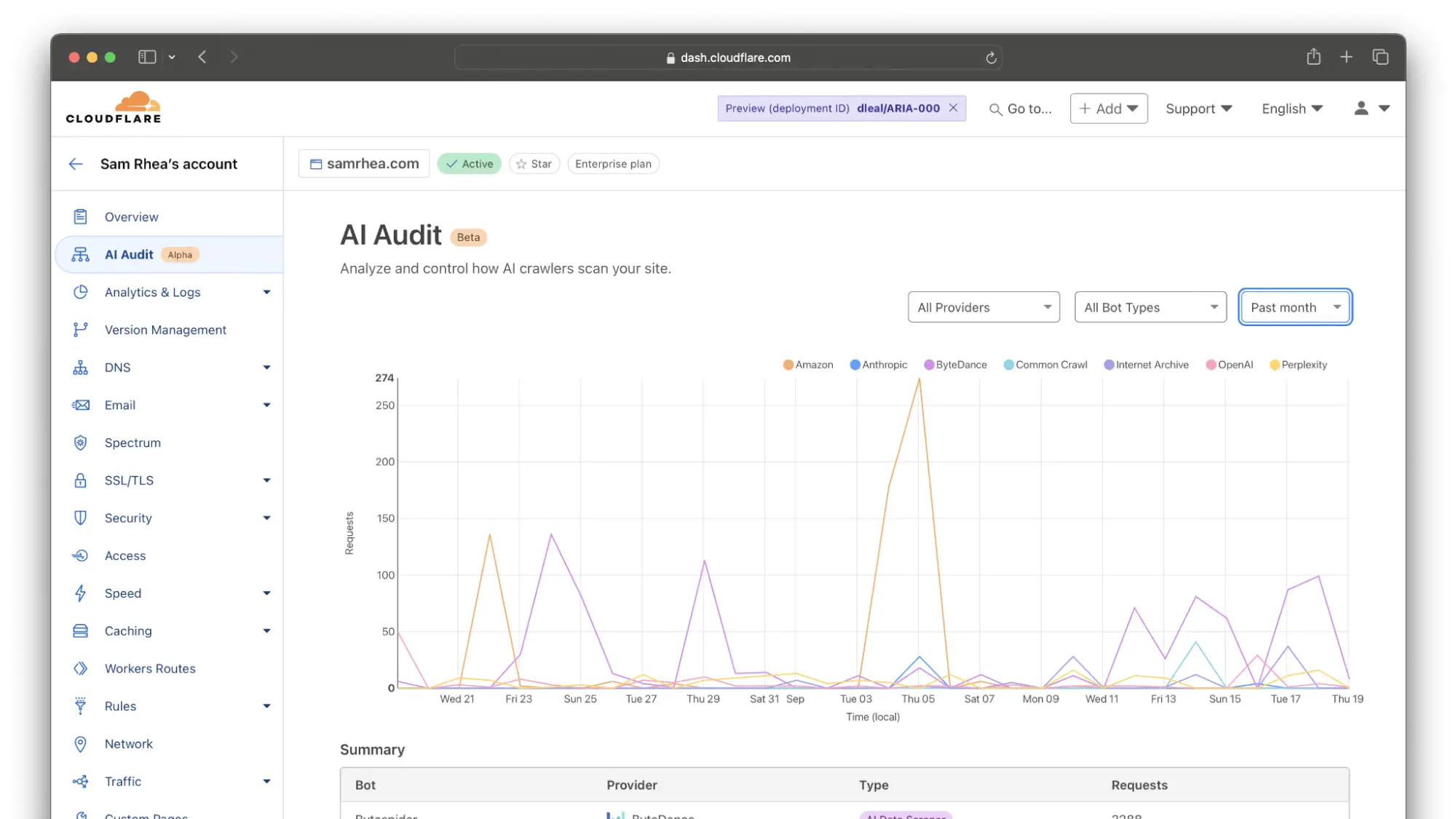
Hardware-free load-balancing eliminates the need to purchase, maintain, and continually upgrade hardware and the associated costs. Servers in over 300 cities minimize latency issues. Products are on every server in its network, so traffic doesn’t get bounced to other locations for filtering services, further minimizing latency. It also interconnects with 8,800 networks globally to provide more efficient data processing and more reliable connectivity.
For organizations that need advanced custom management and reporting, Cloudflare may not offer the visibility and granular control you need. It also lacks network services for SASE and email security. Additionally, users should be prepared to pay for an enterprise subscription if they need timely support.
On the application side, users report it’s complicated to set up and manage, with initial setup being the most complex — made more difficult by the fact that support is unreliable for non-enterprise users.
Cloudflare One offers a compelling SASE solution with extensive global coverage, 100% uptime guarantee, and strong integration capabilities, though it lacks some advanced features and quality support is limited to enterprise subscribers.
7. Versa SASE
Best for: Organizations who are undergoing cloud migration who need hybrid deployment flexibility and multi-tenant support
Pros:
- Deployment flexibility (on-premise, hybrid, or cloud)
- Genuine multi-tenancy
- Accessible and prompt support
Cons:
- More appliance-based than competitors
- Less user-friendly interface
At a Glance:
| Category | Summary |
|---|---|
| Security Features | |
| Includes ZTNA, SW, CASB, RBI, NGFWaaS, SD-WAN, Routing, Analytics, Policy-based automation, Role-Based Access Control (RBAC), Genuine multi-tenancy |
Soc 2 Type 2, ISO9001, ISO14001, ISO20000, ISO27001, ISO22301 certified, HIPAA, GDPR, CCPA compliant, and more |
| Pricing | Unlisted, 90-day free trial for up to 100 users |
|---|---|
| Implementation | Easy to deploy |
| Network Performance | Single-pass parallel architecture to reduce processing overhead |
| Scalability | A wide range of integrations and technology partners, multiple deployment options, and policy-based automation for a strong, scalable solution, as long as your organization doesn’t require detailed threat data |
Founded in 2012, Versa Networks began as a secure SD-WAN platform, meaning that it excels in network performance and routing. It launched its SASE solution in 2020.
Users report it is easy to deploy through multiple deployment options (on-premise, hybrid, or cloud), and, unlike many others in this space, provides accessible and prompt support. It also offers a 90-day free trial, which most competitors don’t.
Versa SASE provides genuine multi-tenancy, allowing organizations to manage multiple tenants securely and efficiently from a single platform. This is particularly useful to managed service providers and enterprises. It uses single-pass parallel architecture, allowing all networking and security functions to be performed only once, reducing processing overhead. The company recently launched new SASE gateways, too, delivering over 100 Gbps throughput.
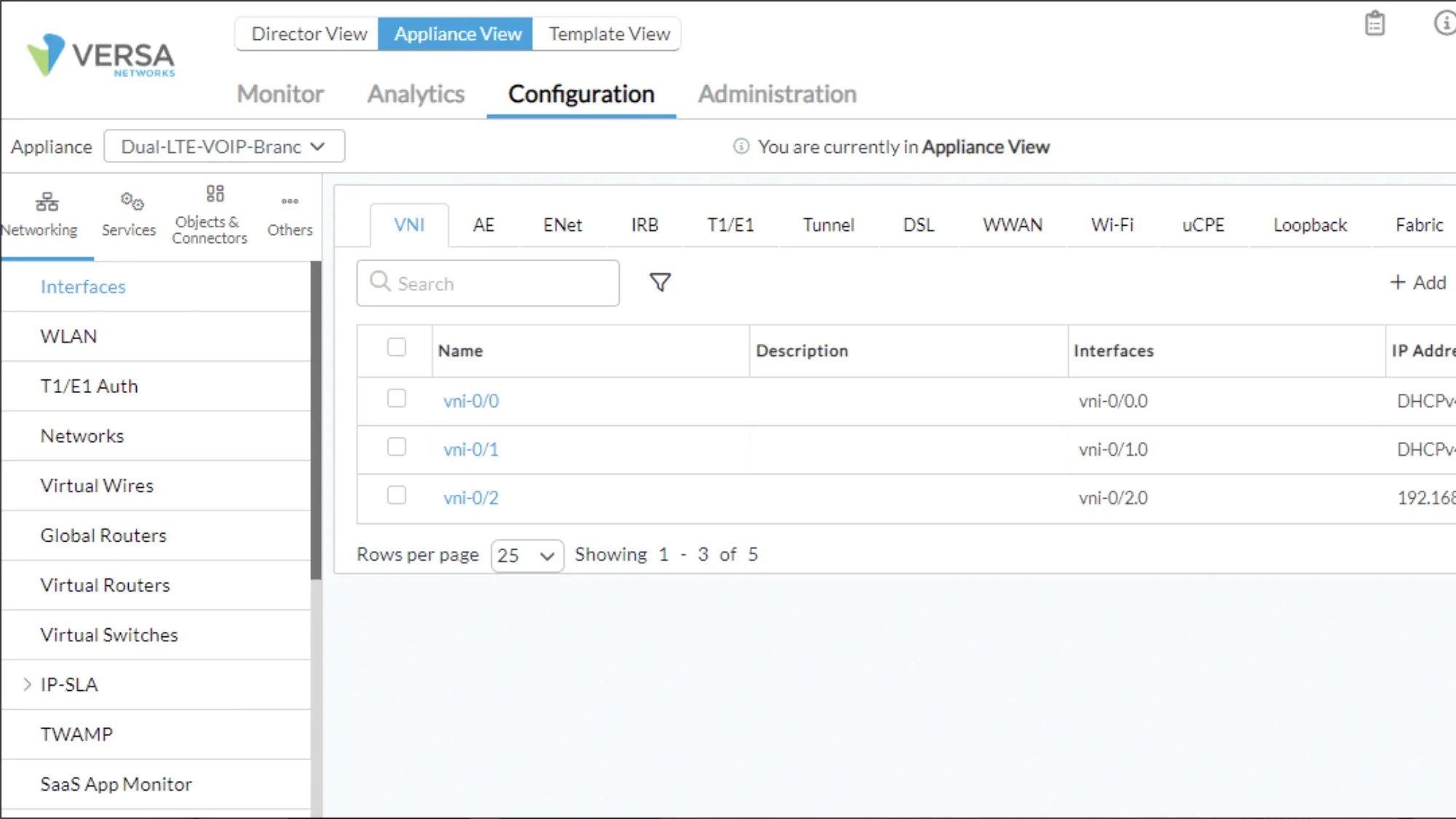
Versa SASE remains more appliance-oriented than fully cloud-native platforms, which can limit agility for fast-scaling cloud-first organizations. The interface isn’t as intuitive as some competitors, which can hinder ease of use and make troubleshooting difficult. Users also report poor documentation, making adoption harder.
Versa SASE is a good option for managed service providers and companies that need multi-tenancy and flexible deployment options. It’s a solid choice for organizations looking to consolidate networking and security under a single platform, especially those still transitioning to the cloud.
8. Harmony SASE (Previously Perimeter 81)
Best for: Organizations that need powerful built-in analytics and policy control, and have the IT expertise to manage a more complex setup
Pros:
- User-friendly once the configuration is in place
- Strong security features and data analytics
Cons:
- Initial setup can be complex
- Poor support
- Endpoint does not integrate well with other tools for logs
At a Glance
| Category | Summary |
|---|---|
| Security Features | |
| ZTNA, FWaaS, SWG, CASB, DLP, ATP, sandboxing, threat analytics, DNS filtering, and more |
SOC2 Type 2 Compliance Certified, ISO27001, ISO27002 Certified, ISO9001 Certified |
| Pricing | Unlisted, 30-day free trial |
|---|---|
| Implementation | Complex to set up, but user-friendly once configurations are in place |
| Network Performance | 70+ PoPs, which is fewer than competitors |
| Scalability | Easy to expand the network due to cloud-native architecture and centralized management in the Infinity Portal |
Launched as Perimeter 81 in 2018 as a ZTNA and Secure Network as a Service provider, it was acquired by Check Point in 2023 and rebranded to Harmony SASE in January of 2024.
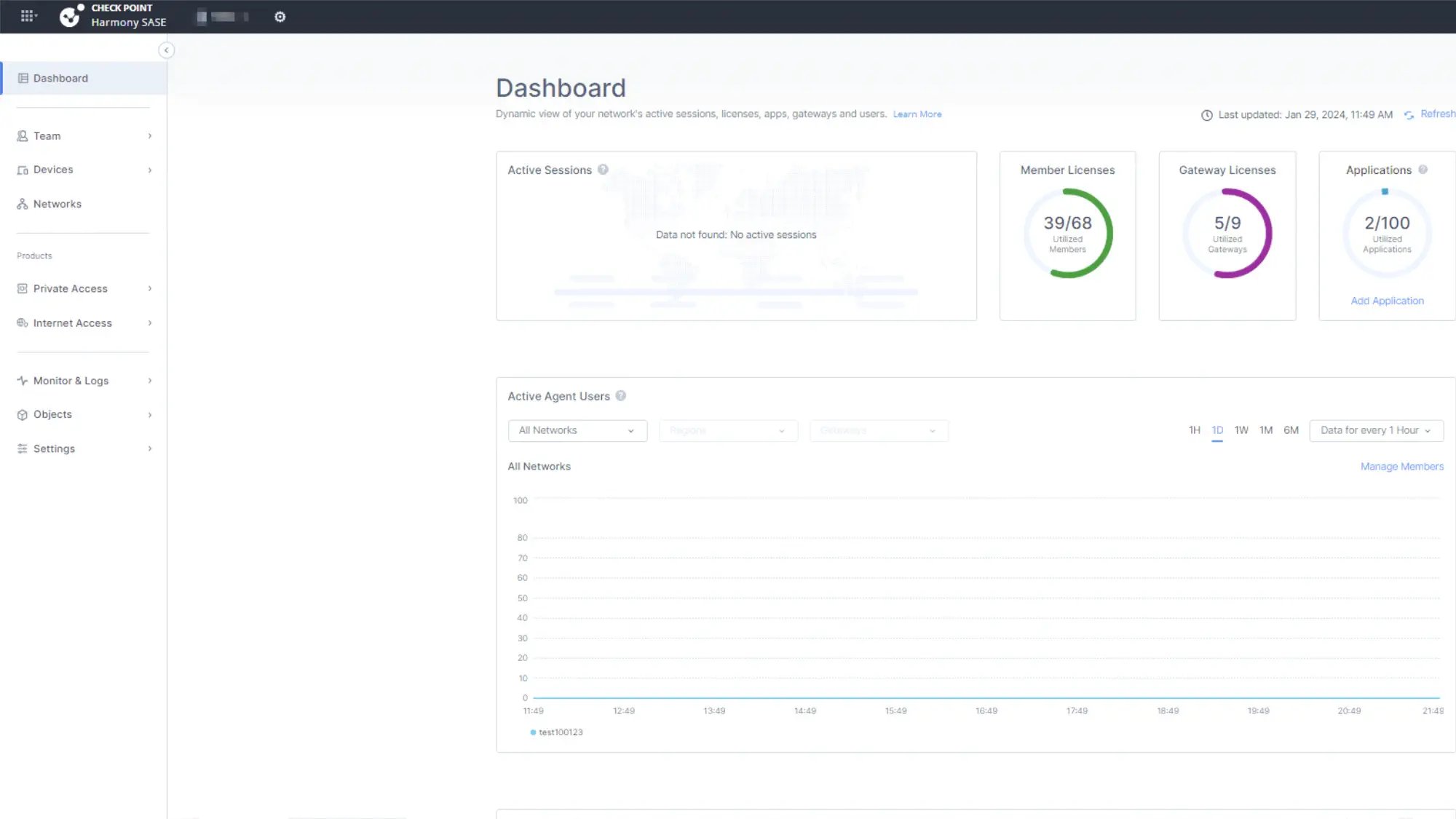
After initial configuration, the solution is very intuitive to use, with strong security features and data analytics. Namely, it offers granular access controls that can be defined by user, application, device, or risk level. It also provides AI-driven threat protection through ThreatCloud, which thoroughly vets every connection to your network.
Though it gets more user-friendly once you’re over the hump, some users find the initial setup complex. The platform also offers around 70-plus PoPs, fewer than many of its competitors, and isn’t as deeply integrated into third-party platforms as other providers. There’s no ARM device support, which could hinder use in mixed environments (such as, cloud and on-perimiter access), and customer support leaves a lot to be desired.
Harmony SASE offers strong security features and robust data analytics. However, this depth of functionality can make initial setup and configuration complex. Additionally, despite its extensive functionality, endpoint integrations don’t work well, especially in mixed network environments where you’d need support for ARM devices, which may hinder deployment flexibility.
9. NordLayer by Nord Security
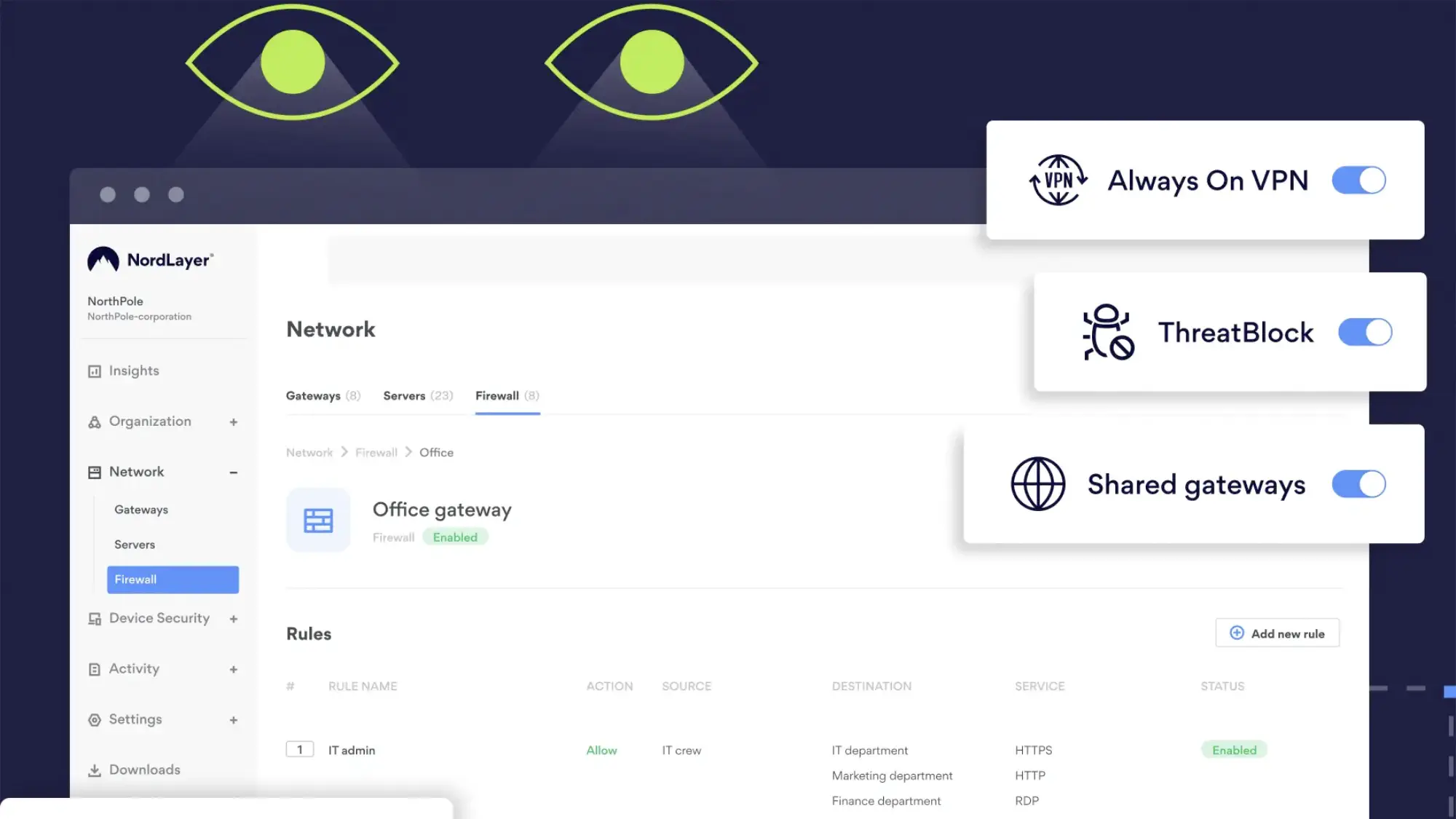
Best for: Price-conscious small and mid-sized organizations that need an easy-to-use, low-maintenance SASE entry point without SD-WAN or complex integrations
Pros:
- Ease of use
- Fast and consistent connection speed
- Flexible and transparent pricing
- Highly scalable
Cons:
- Not a complete SASE solution
- Fewer native integrations than competitors
- Support can be lacking
At a Glance
| Category | Summary |
|---|---|
| Security Features | |
| Includes FWaaS, SWG, zero trust solutions, site-to-site VPN, Dedicated IP, DNS Filtering, DPI, threat prevention, and more |
HIPAA compliant, GDPR compliant, ISO27001 certified, SOC 2 type 1 & 2 certified, and more |
| Pricing | $7 to $14/per user/per month |
|---|---|
| Implementation | Easy to integrate and use |
| Network Performance | Fast and consistent connection speeds |
| Scalability | User-based model to easily add members through the centralized Control Panel |
NordLayer was founded in 2012 as a VPN-only provider and is still owner-owned and operated today, which is rare among providers in this category.
Nord Security first launched its comprehensive business solution — NordVPN Teams — in 2019, which it rebranded as NordLayer in 2024. From there, it began to expand into a more complete SSE platform with a roadmap toward SASE capabilities.
While it doesn’t yet have SD-WAN capabilities, Nord is a good solution for small businesses looking to enhance their security posture with a user-friendly option.
NordLayer stands out for its ease of use and rapid implementation, making it especially appealing to smaller businesses or non-technical teams. Its intuitive interface, centralized control panel, and user-based licensing model simplifies management and scaling. It also offers flexible and transparent pricing.
NordLayer includes built-in security tools like DNS filtering, deep packet inspection, and threat prevention, as well as zero trust network access and dedicated IP options. NordLayer also supports a growing library of integrations for IAM, cloud services, and productivity platforms, although it doesn’t match the depth of integration found in more enterprise-focused solutions.
That said, it’s one of the best and most scalable solutions out there because of its built-in functionality, seamless integrations, and user-friendliness.
While NordLayer is an accessible solution, it isn’t a complete SASE solution yet. It lacks SD-WAN and more advanced network control features. Also, customer support can be inconsistent, especially when contacting through general channels; most users report better outcomes when working directly with a dedicated rep. Additionally, while it offers server locations on all continents, coverage isn’t as extensive as competing services.
NordLayer delivers a strong mix of built-in functionality, user-friendliness, and scalability, which is good for small and mid-sized businesses just starting their SASE journey. That said, it may not meet the needs of large enterprises with sophisticated infrastructure or high customization requirements.
10. Cisco Secure Access Service Edge
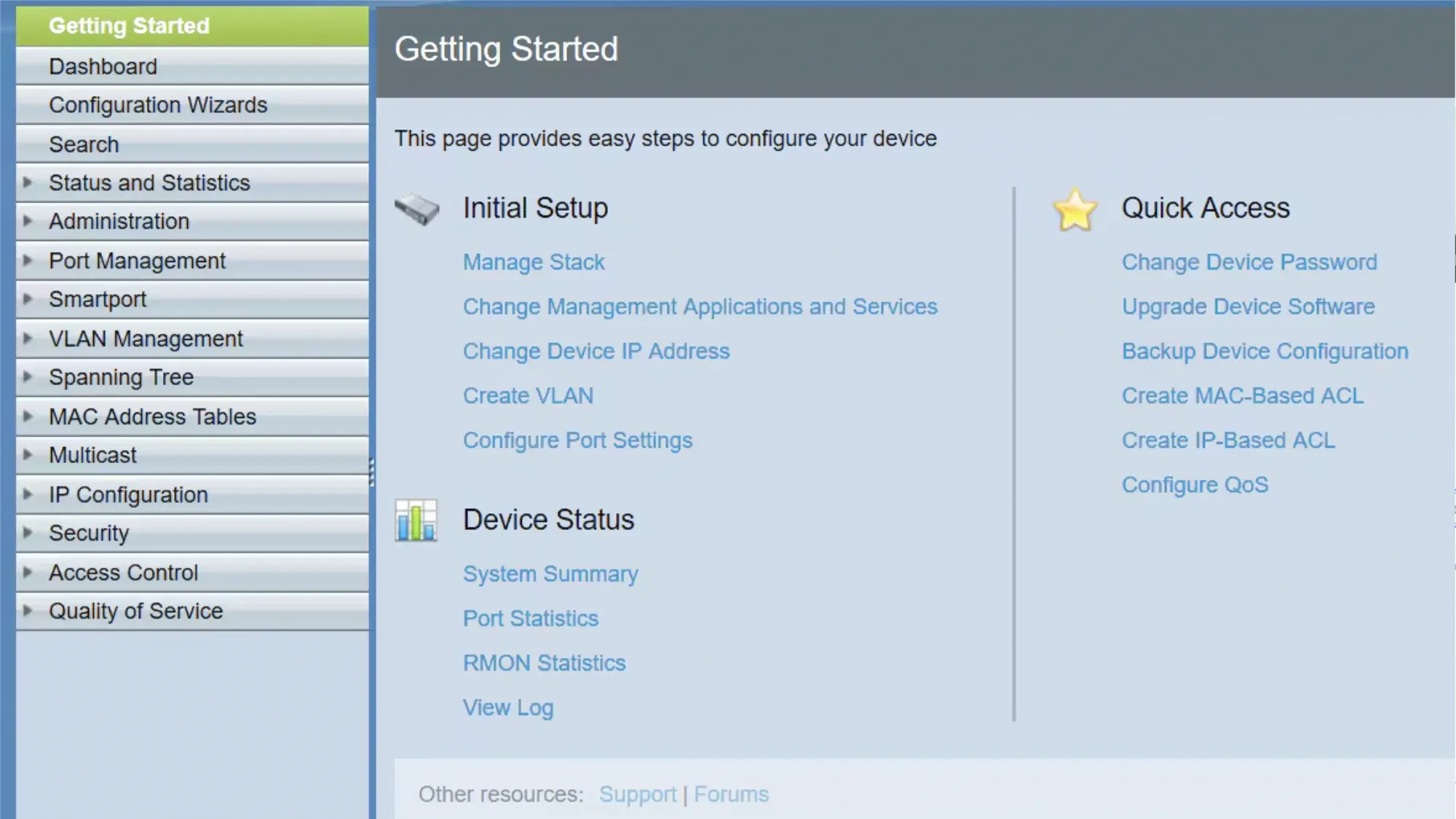
Best for: Large enterprises with existing Cisco infrastructure and generous budgets that prioritize easy deployment and regulatory compliance
Pros:
- Easy implementation
- Strong threat protection
Cons:
- Modular SASE solution
- VPN connectivity issues
- Frequent login issues requiring password resets
- High licensing costs
- Additional fees for technical support
At a Glance:
| Category | Summary |
|---|---|
| Security Features | |
| Includes ZTNA, VPN Access, Secure Internet Access (off VPN), MX Firewall Policy Import Wizard, Cloud-Delivered Firewall (CDFW), Access Posture Control, Remote Access Service, Network Interconnect Intelligent Routing, SD-WAN, SWG, ZTNA, CASB, DNS-layer security, and more |
GDPR Compliant, HIPAA compliant, SOC 2 type 2 certified, and ISO27001, ISO27017, ISO227018, certified, and more |
| Pricing | Unlisted/custom quoted |
|---|---|
| Implementation | Easy to implement |
| Network Performance | Inconsistent performance and frequent login issues |
| Scalability | Requires integrations for some core SASE features; inconsistent performance |
Founded in 1984, Cisco launched its SASE solution in March of 2021. Building a full SASE architecture with Cisco typically requires multiple products from across its portfolio. Unlike some competitors who offer a unified SASE platform, Cisco takes a more modular approach.
Cisco is a well-established security provider with a comprehensive feature set, but users complain that poorly configured product integrations in recent years have weakened the platform.
Cisco Secure Client and other popular products are easy to implement and use, a relatively rare highlight in a SASE solution. It also has strong threat detection capabilities through XDR and Secure Endpoint integrations.
The ease of implementation comes at the cost of comparatively little built-in functionality, long-term service issues, and a high price tag. Cisco users complain that licensing costs are predatory, and most functionality comes from integrations, so you aren’t saving as much on shadow IT costs as you might with other solutions that have more built-in features.
Users also complain that Cisco APIs are inconsistent and lack documentation. IdP end-user authentication and SD-WAN are only available through integrations.
Cisco requires users to pay for additional technical support, which many users report is a bad experience — everything from getting hung up on to unresolved ticket issues. Many users complain of connectivity issues, especially with the VPN features, and frequent login issues requiring password resets.
Cisco’s new Secure Client SASE solution offers improved integration capabilities and easy implementation compared to its previous offering, though it suffers from limited built-in functionality, connectivity issues, questionable technical support, and high licensing costs that undermine its value for some users.
How SASE Stacks Up with Other Security Models
SASE is purpose-built for a world where remote work, BYOD, and cloud apps are the norm.
Traditional and hybrid network architectures, by comparison, weren’t designed for the level of flexibility most modern workplaces need — they struggle with visibility, performance, and security consistency in today’s decentralized environments.
Traditional Network Architecture
Traditional models route all traffic through a centralized data center using VPNs and on-premise firewalls. This worked great when everyone was in the office, but not so much when users, devices, and apps are everywhere.
In a distributed environment, this setup causes latency issues — not to mention security gaps, when frustrated users abandon their VPNs altogether due to lags.
Hybrid Network Architecture
Then came a major innovation: hybrid network architecture, which combines on-premise infrastructure with cloud-based services. This model emerged as a way for organizations to reduce the high latency issues associated with fully centralized, legacy networks, while supporting the scalability and flexibility required by modern business needs.
While it offers benefits like reduced network congestion and more flexible remote access, hybrid architecture often results in fragmented security policies, inconsistent access controls, and operational complexity as teams manage multiple platforms and vendors.
That’s why SASE is quickly becoming the future of enterprise security. By unifying networking and security in the cloud, it delivers unparalleled visibility, agility, and consistent protection that modern organizations need.
Benefits of SASE Security Solutions
Shifting to a SASE framework provides serious advantages over more fragmented traditional or hybrid security architectures. By converging networking and security into a unified, cloud-delivered service, SASE directly tackles the complexities and inefficiencies of modern IT environments. This not only strengthens security posture but also improves operational workflows and user experience.
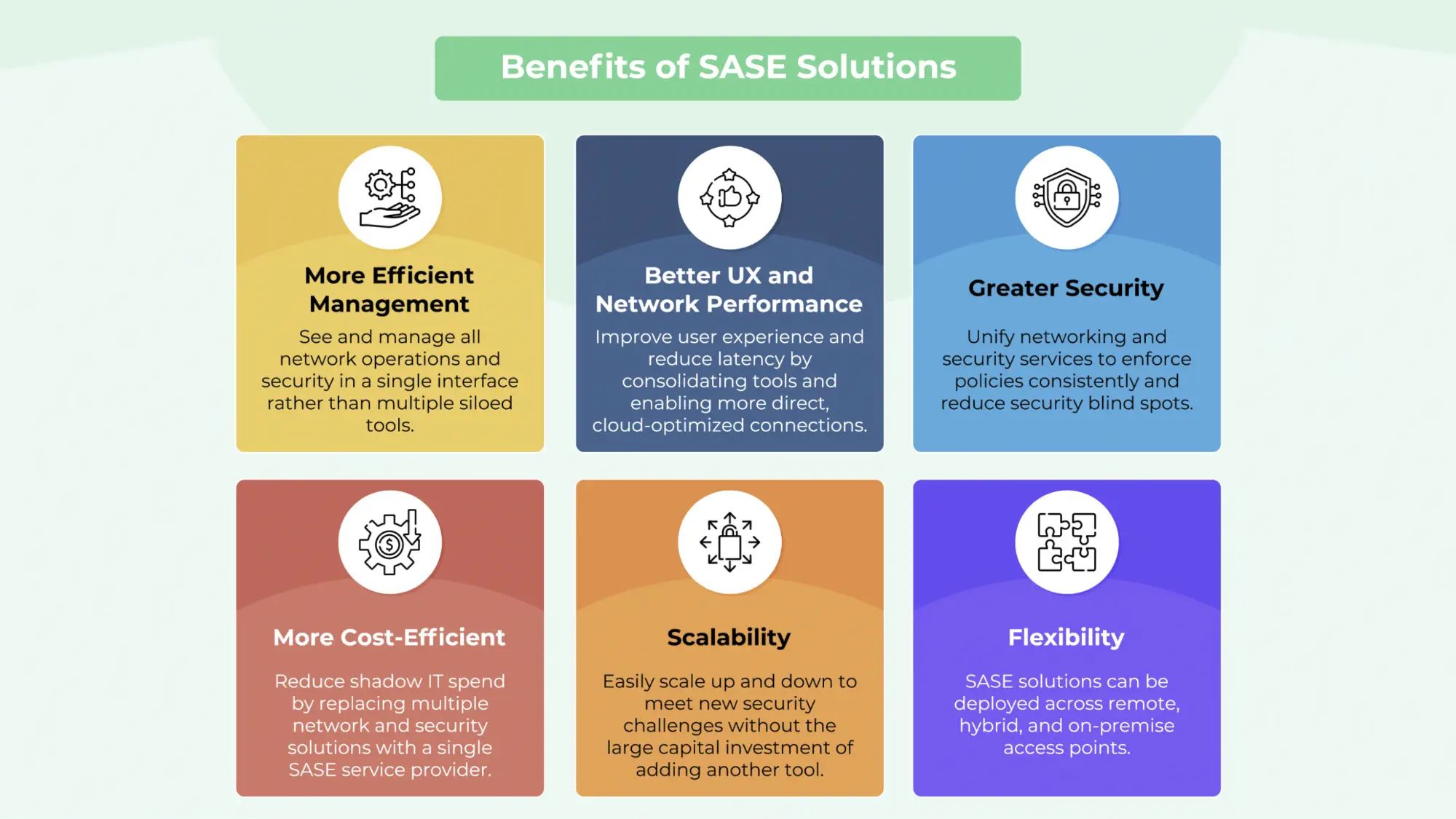
Here are some of the key benefits businesses can realize with SASE:
More efficient management: No more juggling multiple tools and security profiles (and the vulnerabilities that come with it) — SASE dramatically simplifies operations by consolidating numerous point products into a single platform, offering centralized visibility and control over both network and security functions through one interface.
Better UX and network performance: Users get improved application performance and reduced frustration thanks to direct, optimized routing and the elimination of latency often caused by back hauling traffic through VPNs or centralized data centers.
Greater security: The unified model closes security gaps common between disparate tools, enables consistent policy enforcement across all users and locations, and ultimately reduces overall risk by providing comprehensive, context-aware protection.
More cost-efficient: Organizations often see significant long-term cost savings by replacing multiple security and networking tools either partially or altogether (like VPNs) with a single SASE solution, thereby reducing licensing complexity, hardware needs, and operational overhead.
Scalability: The cloud-native nature of SASE allows businesses to easily scale their security services up or down based on evolving needs, without the large capital expenditures typically associated with traditional hardware deployments.
Flexibility: SASE delivers consistent security policies and secure access for all users and devices regardless of their location, effectively supporting remote, hybrid, and traditional on-premises work models.
What option to choose?
The Future of Cybersecurity Is SASE
As company environments continue to transform — and increasingly in the direction of remote, globally distributed work — SASE architecture emerges not just as an option, but as possibly the best assurance you have against the dissolution of traditional security perimeters. It provides the crucial combination of integrated networking and security needed to protect decentralized environments from sophisticated modern threats.
Making an informed choice and partnering with a strong SASE provider is integral to building a resilient, agile, and more secure future for your business. Check out our curated list of security and network providers to get started implementing a SASE solution at your organization today.